How do you give a gift, say more than “thank you” and politely ask for an exchange? Learn 15 French phrases with examples and nuances for the holidays or a birthday.
You open a parcel and want to say something beyond « c’est bien ». Or you need to tell a shop assistant that an item is unsuitable without sounding blunt. Gift vocabulary is useful both with friends and in shops.
This guide focuses on those specific situations rather than a general Christmas vocabulary list. The phrases also work for invitations, farewells and birthdays.
Giving a gift naturally
1. « J’ai pensé à toi en voyant ça. » — I thought of you when I saw this.
Explain why you chose the item: « J’ai pensé à toi en voyant ce livre sur la cuisine. » The focus is on thinking of the other person.
2. « C’est une petite attention. » — It is a little something for you.
Here, « une attention » means a thoughtful gesture. It lets you introduce a small gift without emphasising its value. It does not mean you chose it carelessly.
3. « J’espère que ça te plaira. » — I hope you will like it.
« Plaire » refers to the person something appeals to: « Ce livre me plaît. » For several people or a formal address: « J’espère que ça vous plaira. »
4. « Je ne savais pas lequel choisir. » — I did not know which one to choose.
Use « lequel » for a masculine noun and « laquelle » for a feminine one: « Il y avait deux écharpes, je ne savais pas laquelle choisir. » Plural forms are « lesquels » and « lesquelles ».
5. « Tu peux l’ouvrir maintenant si tu veux. » — You can open it now if you like.
This is an invitation, not an obligation. « L’ » can replace « le paquet » or « le cadeau ». Depending on the situation, the person may prefer to open it later.
Reacting and expressing thanks
6. « Merci, ça me fait vraiment plaisir ! » — Thank you, that means a lot to me!
Express your pleasure at the gesture. This works in many situations and does not require exaggerating your enthusiasm for the object.
7. « Il ne fallait pas ! » — You should not have!
When receiving a gift, this can express grateful surprise: « Oh, il ne fallait pas ! Merci beaucoup. » With a different tone or context, it can also be a genuine criticism.
8. « C’est exactement ce qu’il me fallait. » — It is exactly what I needed.
The gift meets a real need: « Mon ancien carnet était plein : c’est exactement ce qu’il me fallait ! » Use it only when it reflects how you feel.
9. « Tu as bien choisi ! » — You chose well!
Compliment the choice and add a detail: « Tu as bien choisi, j’adore cette couleur. » A specific compliment often sounds more natural than a string of superlatives.
10. « C’est très gentil d’avoir pensé à moi. » — It is very kind of you to have thought of me.
Thank the person for the gesture. This is useful when you appreciate their thoughtfulness without wanting to discuss the gift at length.
Asking for help or an exchange in a shop
11. « Je cherche un cadeau pour quelqu’un qui aime lire. » — I am looking for a gift for someone who likes reading.
Give the assistant something specific. Replace « lire » with « cuisiner » or « voyager », and mention your budget if you wish.
12. « Est-ce que vous faites des paquets cadeaux ? » — Do you offer gift wrapping?
Do not assume the service is free: add « Est-ce que c’est payant ? » if needed.
13. « Est-ce que je peux avoir un ticket cadeau ? » — Could I have a gift receipt?
Some shops offer a receipt designed for gifts. Services and conditions vary: ask what it allows rather than assuming an exchange will always be possible.
14. « Est-ce que ce serait possible de l’échanger ? » — Would it be possible to exchange it?
The conditional softens your request: « J’ai reçu ce pull, mais il est trop petit. Est-ce que ce serait possible de l’échanger ? » The answer depends on the seller’s conditions.
15. « Vous l’auriez dans une autre taille ? » — Would you have it in another size?
This is a common polite request. For colour: « Vous l’auriez en bleu ? » The pronoun « l’ » replaces the item you are discussing.
Offrir, donner, rendre: three different verbs
« Offrir » focuses on giving a gift: « Je lui offre un livre. » « Donner » is broader: « Je lui donne mon adresse. » You can also « donner un cadeau », but « offrir » naturally highlights the intention.
« Rendre » can mean to give something back: « Je te rends le livre que tu m’as prêté. » In the passé composé: j’ai offert, j’ai donné, j’ai rendu. For a gift you received, say « On m’a offert ce livre », not « on m’a offert avec ce livre ».
Practise a short scene
— Tiens, j’ai pensé à toi en voyant ça.
— Oh, merci ! Je peux l’ouvrir ?
— Bien sûr, j’espère que ça te plaira.
— Tu as bien choisi, j’adore les histoires policières !
Read the scene, then replace the book with a scarf. Change the last reply to mention its colour or fabric. This helps you practise a personal reaction rather than recite a stock phrase.
Check what you remember
Turn vocabulary into conversation
Want to use your French in real conversations? Explore my Objectif : Parler français books. Choose the level that suits you and practise with dialogues and native-speaker audio. Read a passage, listen to it, then adapt a few sentences to talk about your own life.
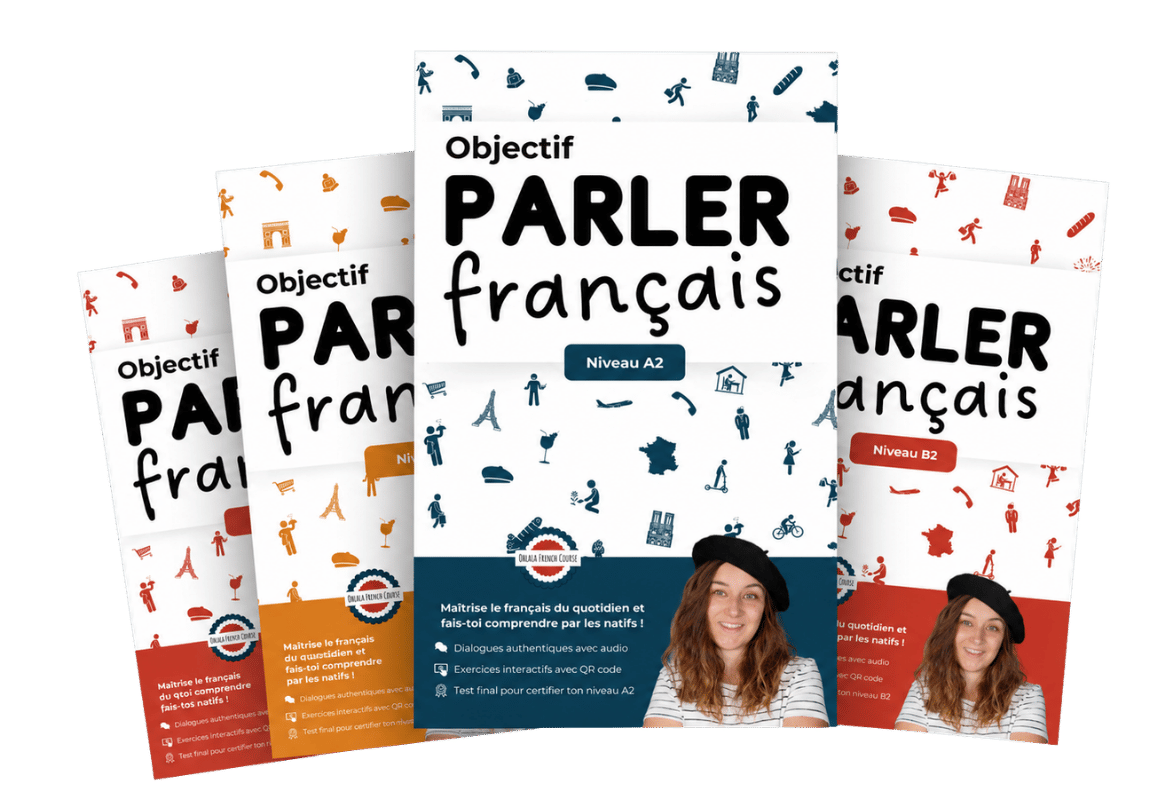
Explore the Objectif : Parler français books
A. Complete: « J’espère que ça te ___. »
B. Which verb means to return a borrowed object?
C. Make this more polite: « Je veux une autre taille. »
Answers: A. plaira; B. rendre; C. « Vous l’auriez dans une autre taille ? » A gift is an opportunity to connect: a sincere, simple sentence followed by one personal detail is often enough.