30 days to speak French with confidence: take your first step
You understand French, but as soon as someone asks you a question, you freeze. You search for words, check your grammar and wonder whether your accent sounds right. By the time you have prepared an answer, the conversation has sometimes moved on.
You may tell yourself: ‘Once I know more vocabulary, I’ll finally be able to speak.’ Yet learning more does not always make it easier to speak up. Confidence also grows when you use the French you already know.
This article offers three practical ways to get started, along with two small exercises you can try right now. To build on those first steps, join my free challenge: 30 days to speak French with confidence. The aim is not perfect French in a month. It is to stop putting off your first sentence.
Contents
- 1. Don’t wait until you feel ready to speak
- 2. Aim to be understood, not perfect
- 3. Prepare a starting point, not the whole conversation
- A free challenge to keep going for 30 days
- The programme: four weeks to move forward
- What if you are shy or your French is still limited?
- Your next conversation can start with one sentence
1. Don’t wait until you feel ready to speak
Learning to speak French is a little like learning to swim. Videos, advice and explanations can help, but eventually you need to get into the water. That does not mean starting out of your depth. You can begin somewhere you feel safe.
The same applies to French. Your first step does not have to be a long discussion with several fast speakers. You can say one sentence at home, ask someone you know a simple question or answer with a few words instead of just smiling.
Confidence is not something you wait for. It is something you build, step by step.
Your first exercise: ‘Je vois…’
Look around and choose something you can see. Complete this sentence out loud: ‘Je vois…’ (I see…). For example: ‘Je vois un livre sur la table.’ (I see a book on the table.)
If you do not know the name of the object, choose another one. The point is not to make a difficult sentence. It is to use French to say something, rather than keeping all your words in your head.
Speaking alone is not the same as speaking with another person, but this small action can be a starting point. You do not have to choose the hardest situation for your effort to matter.
2. Aim to be understood, not perfect
If your goal is to make no mistakes, every conversation becomes a test. You monitor your accent, verb forms, agreements and vocabulary, leaving less room to listen to the person in front of you.
Try a simpler intention: ‘I want to get one idea across.’ One idea is enough to take part in an exchange.
Someone asks: ‘Qu’est-ce que tu as fait ce week-end ?’ (What did you do this weekend?) You do not need one complicated sentence. You can say: ‘Samedi, j’ai vu une amie. On a mangé ensemble. C’était sympa.’ (On Saturday, I saw a friend. We ate together. It was nice.) Three short sentences provide a real answer and allow the conversation to continue.
What if you forget a word? Explain it another way. If you cannot remember ‘boulangerie’ (bakery), try: ‘Le magasin où on achète du pain.’ (The shop where you buy bread.) You have not found the exact word, but you have found a way to communicate.
Grammar and pronunciation still matter: they help you express yourself clearly. But you can improve them without demanding perfection whenever you speak. Searching for a word, starting a sentence again and asking someone to repeat are also ways of taking part.
3. Prepare a starting point, not the whole conversation
‘What if I don’t know what to say next?’ This worry can make you prepare every possible answer before you even begin. It is exhausting, and nobody can predict an entire conversation.
Instead, prepare one opening sentence and one sentence to ask for help. This small support can be more useful than a long memorised script.
To begin: ‘J’apprends le français et j’aimerais pratiquer un peu.’ (I’m learning French and I’d like to practise a little.)
To ask for help: ‘Tu peux parler un peu plus lentement, s’il te plaît ?’ (Could you speak a little more slowly, please?)
In a more formal situation, use ‘vous’: ‘Vous pouvez parler un peu plus lentement, s’il vous plaît ?’
Your second exercise: choose your first sentence.
Think of a situation in which you would like to speak French: ordering something, chatting with a colleague or meeting someone new. What would your very first sentence be?
Do not prepare the next ten sentences. Just choose your starting point and say it out loud. Even a very simple sentence gives you a way to open the exchange.
A free challenge to keep going for 30 days
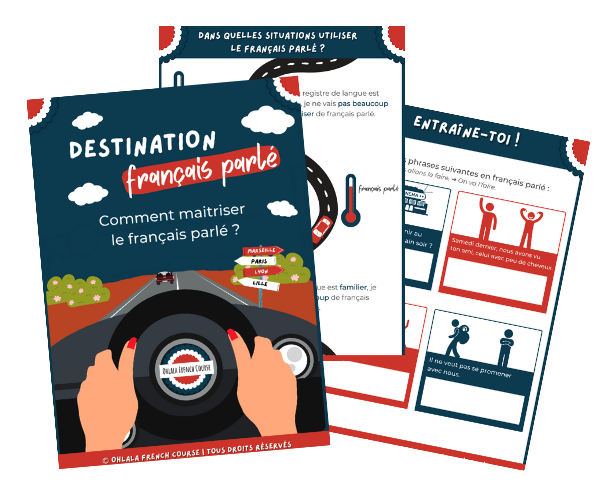
These small exercises can help you get started. Tomorrow, though, you might wonder: ‘What do I actually do now?’ That is why I created my free challenge: 30 days to speak French with confidence.
For 30 days, you receive a short email from me each day. It includes a reflection or a new perspective, a quick exercise or a question to engage your mind, and a small, accessible action you can try straight away.
The idea is simple: read the email, take a few minutes for yourself and try the small action. You do not need to add a huge French study session to an already busy day. Instead, create a regular moment to use French and give yourself permission to try.
The challenge emails are in French. The programme includes a welcome email, 30 days of the challenge and follow-up emails through day 37. You can unsubscribe at any time using the link in each email.
🎁 Join the free challenge
30 days, one short daily email and one small action to help you speak French with confidence. Emails are in French.
The programme: four weeks to move forward
Week 1 — Mindset. We look at fear, stress and the thoughts that arise when you want to speak: ‘I’ll bother people’, ‘My accent is ridiculous’, ‘I’m not good enough’. The aim is not to tell you to stop being afraid. It is to explore small actions you can take even before you feel completely comfortable.
Week 2 — Pronunciation. We focus on speaking more clearly and naturally, not erasing your accent or turning you into a native speaker. You can have an accent and still be understood. Communication remains the goal.
Week 3 — Vocabulary and expression. We work with useful words and phrases for real situations rather than a long list to memorise. Recognising a word on the page and using it in conversation are different skills. The aim is to connect the two.
Week 4 — Grammar and fluency. We focus on sentence structure and clarity so you can express an idea simply. Grammar becomes a tool to help you speak, not a condition you must meet before joining a conversation.
Each week prepares you for the next. You gradually move from ‘I understand, but I don’t dare speak’ towards ‘I can try with the words I already know’.
What if you are shy or your French is still limited?
You do not need to become a different person to speak French. You can remain a quiet person and learn to take your place in a conversation, one small sentence at a time.
If you understand French but struggle to speak up, that is precisely the gap this challenge is designed to address. You start with what you already know and begin putting it into practice. Remember that the daily emails are in French, so you will need to be able to follow short written instructions in French.
I cannot promise that after 30 days you will never feel afraid again, or that you will speak fluently in every situation. What I offer is a simple framework to practise regularly, gradually change your relationship with mistakes and speak up more often.
You do not need to complete every exercise perfectly. You need to give yourself permission to try.
Your next conversation can start with one sentence
Think back to the sentence you said with ‘Je vois…’, or the opening phrase you chose. It may not have been perfect, but you said it. That is already a first step.
Instead of waiting another month to feel ready, why not use that month to build confidence? In the free challenge, we move forward together: one short daily email, a reflection, a quick exercise and a small action.
No pressure, no perfection: just one small step after another. Your next conversation does not have to be perfect. It can simply begin with a sentence.
🎁 Join the free challenge
30 days, one short daily email and one small action to help you speak French with confidence. Emails are in French.