You may know the French words “marcher”, “coup” or “courant”. Yet when someone says “Ça marche” or “Je te tiens au courant”, translating each word does not explain the conversation. These short phrases have their own meaning and appear frequently in everyday French.
Here are 30 useful French expressions, with meanings, practical examples and pronunciation. They are organized into three groups: reacting, handling everyday situations and following a conversation. Two mini quizzes help you check what you remember.
How to read the pronunciation notes
The transcriptions in brackets use the International Phonetic Alphabet. [ɑ̃], [ɛ̃] and [ɔ̃] represent nasal vowels; [ʃ] is the sound in “chat” and [ʒ] the sound in “je”. These are reference pronunciations: in fast conversation, some unstressed e sounds may disappear.
You do not need to master every symbol to get started. Read the examples aloud and use the accompanying video lesson to hear an oral model. Focus on five expressions you could use this week.
Contents
1. React naturally
1. Ça marche
Pronunciation : [sa maʁʃ]
You are accepting a suggestion: this is a natural way to say “sounds good”. It can also mean that something works.
Example:
— On se retrouve à 18 heures ?
— Ça marche !
— Shall we meet at 6 pm?
— Sounds good!
Remember: The French r is followed by [ʃ], the sound in “chat”.
2. Ça dépend
Pronunciation : [sa depɑ̃]
Your answer depends on the circumstances. Add a detail so the other person knows what you mean.
Example:
— Tu travailles demain ?
— Ça dépend. Peut-être le matin.
— Are you working tomorrow?
— It depends. Maybe in the morning.
Remember: The final vowel is nasal; the final d is silent.
3. Ça vaut le coup
Pronunciation : [sa vo lə ku]
An activity or purchase is worth the time, effort or money involved. In this expression, the spelling is “coup”, not “coût”.
Example:
Le musée est un peu loin, mais ça vaut le coup.
The museum is a bit far away, but it’s worth it.
Remember: The t in “vaut” and the p in “coup” are silent. There is no liaison before “le”.
4. Ça me va
Pronunciation : [sa mə va]
A suggestion suits you. “Ça me va” emphasizes that a time or solution works for you, rather than showing excitement.
Example:
— On déjeune à midi ?
— Oui, ça me va.
— Shall we have lunch at noon?
— Yes, that works for me.
Remember: You can also say “Cette veste me va bien” to mean that a jacket fits or suits you.
5. Pas de souci
Pronunciation : [pa də susi]
You reassure someone that there is no problem. This phrase is common in everyday conversation.
Example:
— Désolé, j’aurai cinq minutes de retard.
— Pas de souci.
— Sorry, I’ll be five minutes late.
— No problem.
Remember: In “souci”, c is pronounced [s], not [k].
6. Tant mieux
Pronunciation : [tɑ̃ mjø]
You respond to good news or an improvement in the situation.
Example:
— Finalement, il ne va pas pleuvoir.
— Ah, tant mieux !
— It’s not going to rain after all.
— Oh, that’s good!
Remember: The final t in “tant” and the x in “mieux” are silent.
7. Tant pis
Pronunciation : [tɑ̃ pi]
You accept a disappointment or a problem you cannot change. “Tant pis” expresses resignation, unlike “tant mieux”.
Example:
— Il n’y a plus de billets.
— Tant pis, on ira une autre fois.
— There are no tickets left.
— Oh well, we’ll go another time.
Remember: The final s in “pis” is silent.
8. Ça m’étonne
Pronunciation : [sa metɔn]
Some information surprises you. Depending on the context, you may also be expressing doubt.
Example:
— Paul est arrivé en avance.
— Ah bon ? Ça m’étonne !
— Paul arrived early.
— Really? That surprises me!
Remember: “Étonne” does not contain a nasal vowel: you pronounce the consonant n.
9. J’en ai marre
Pronunciation : [ʒɑ̃ nɛ maʁ]
You are fed up with a recurring or frustrating situation. This is informal; “J’en ai assez” is more neutral in a formal exchange.
Example:
Le train est encore en retard. J’en ai marre !
The train is late again. I’m fed up!
Remember: You hear an n between “en” and “ai”: [ʒɑ̃ nɛ].
10. Ça me dit
Pronunciation : [sa mə di]
An idea appeals to you. A positive answer often uses “Ça me dit bien”. “Ça ne me dit rien” means you do not feel like it.
Example:
— On va boire un café ?
— Oui, ça me dit bien.
— Shall we go for a coffee?
— Yes, I’d like that.
Remember: The final t in “dit” is silent.
Mini quiz 1
Try answering before looking at the suggested answers.
- Your friend suggests a restaurant and you like the idea. How do you express your interest?
- Your train is cancelled again and you have had enough. What informal phrase can you use?
- A 10 am appointment fits your schedule. How do you reply?
Suggested answers: 1. « Ça me dit bien. » · 2. « J’en ai marre ! » · 3. « Ça me va. »
2. Handle everyday situations
11. Ça tombe bien
Pronunciation : [sa tɔ̃b bjɛ̃]
Something happens at just the right time and fits what you need.
Example:
— J’ai fait trop de gâteau.
— Ça tombe bien, j’ai très faim !
— I made too much cake.
— That’s good timing: I’m really hungry!
Remember: “Tombe” and “bien” contain nasal vowels; the b in “tombe” is pronounced.
12. Ça ne fait rien
Pronunciation : [sa nə fɛ ʁjɛ̃]
You reassure someone about a small mistake or something they forgot: it does not matter.
Example:
— Désolé, j’ai oublié ton livre.
— Ça ne fait rien.
— Sorry, I forgot your book.
— It doesn’t matter.
Remember: In spoken French, you will often hear “Ça fait rien”, without “ne”.
13. Je m’en fiche
Pronunciation : [ʒə mɑ̃ fiʃ]
You have no preference, or the subject does not matter to you. This informal phrase can sound dismissive. At work, “Je n’ai pas de préférence” or “Cela m’est égal” is safer.
Example:
— Tu préfères manger italien ou japonais ?
— Je m’en fiche, les deux me plaisent.
— Would you rather have Italian or Japanese food?
— I don’t mind; I like both.
Remember: The [ɑ̃] sound in “m’en” is nasal.
14. N’importe quoi !
Pronunciation : [nɛ̃pɔʁt kwa]
You consider a statement absurd or false. Used this way, it is a direct reaction: take care when contradicting someone.
Example:
— Les Français mangent des croissants tous les matins.
— Mais c’est n’importe quoi !
— French people eat croissants every morning.
— That’s nonsense!
Remember: The t in “importe” is pronounced: it is part of the word, not a liaison.
15. Ça y est
Pronunciation : [sa jɛ]
An action is finished, or an awaited moment has finally arrived. The context tells you what has happened.
Example:
— Tu as fini ton travail ?
— Oui, ça y est !
— Have you finished your work?
— Yes, it’s done!
Remember: “Y est” forms a smooth [jɛ] sound. Another example: “Ça y est, nous sommes en vacances !” — We’re finally on holiday!
16. J’arrive
Pronunciation : [ʒaʁiv]
You are coming or will be there shortly. It does not necessarily mean you are already at the door.
Example:
— Tu es où ?
— J’arrive, je suis à deux minutes.
— Where are you?
— I’m coming; I’m two minutes away.
Remember: The final e is silent; you do pronounce the v.
17. Je te tiens au courant
Pronunciation : [ʒə tə tjɛ̃ o kuʁɑ̃]
You promise to share news once you have more information. When addressing someone formally, use “Je vous tiens au courant”.
Example:
— Tu sais si la réunion est confirmée ?
— Pas encore. Je te tiens au courant.
— Do you know whether the meeting is confirmed?
— Not yet. I’ll keep you posted.
Remember: In fast speech, the unstressed e in “je” may disappear. “Tiens” and “courant” contain nasal vowels.
18. On verra
Pronunciation : [ɔ̃ vɛʁa]
You leave a decision until later. Depending on the intonation, this can also be a way of avoiding a promise.
Example:
— Tu viens avec nous ce week-end ?
— Peut-être. On verra.
— Are you coming with us this weekend?
— Maybe. We’ll see.
Remember: In “on”, do not pronounce a separate n: the vowel is nasal.
19. Je suis partant
Pronunciation : [ʒə sɥi paʁtɑ̃]
You are interested and want to join in. A woman says “Je suis partante”. This is more enthusiastic than simply saying “Ça me va”.
Example:
— On organise un pique-nique dimanche ?
— Oui, je suis partant !
— Shall we organize a picnic on Sunday?
— Yes, I’m in!
Remember: The final t in “partant” is silent; in “partante” [paʁtɑ̃t], you hear it.
20. Ça te dérange si… ?
Pronunciation : [sa tə deʁɑ̃ʒ si]
You politely check whether your action would bother someone. With someone you address as “vous”, use “Ça vous dérange si… ?”.
Example:
— Ça te dérange si j’ouvre la fenêtre ?
— Non, pas du tout.
— Do you mind if I open the window?
— No, not at all.
Remember: “Non” means that the person does not mind: you can open the window.
Mini quiz 2
Try answering before looking at the suggested answers.
- You are waiting for confirmation and promise to pass on the answer. What do you say?
- You want to open a window without bothering someone. What do you ask?
- A friend suggests going out and you want to join. How do you show enthusiasm?
Suggested answers: 1. « Je te tiens au courant. » · 2. « Ça te dérange si j’ouvre la fenêtre ? » · 3. « Je suis partant / partante ! »
Move from individual expressions to real conversations
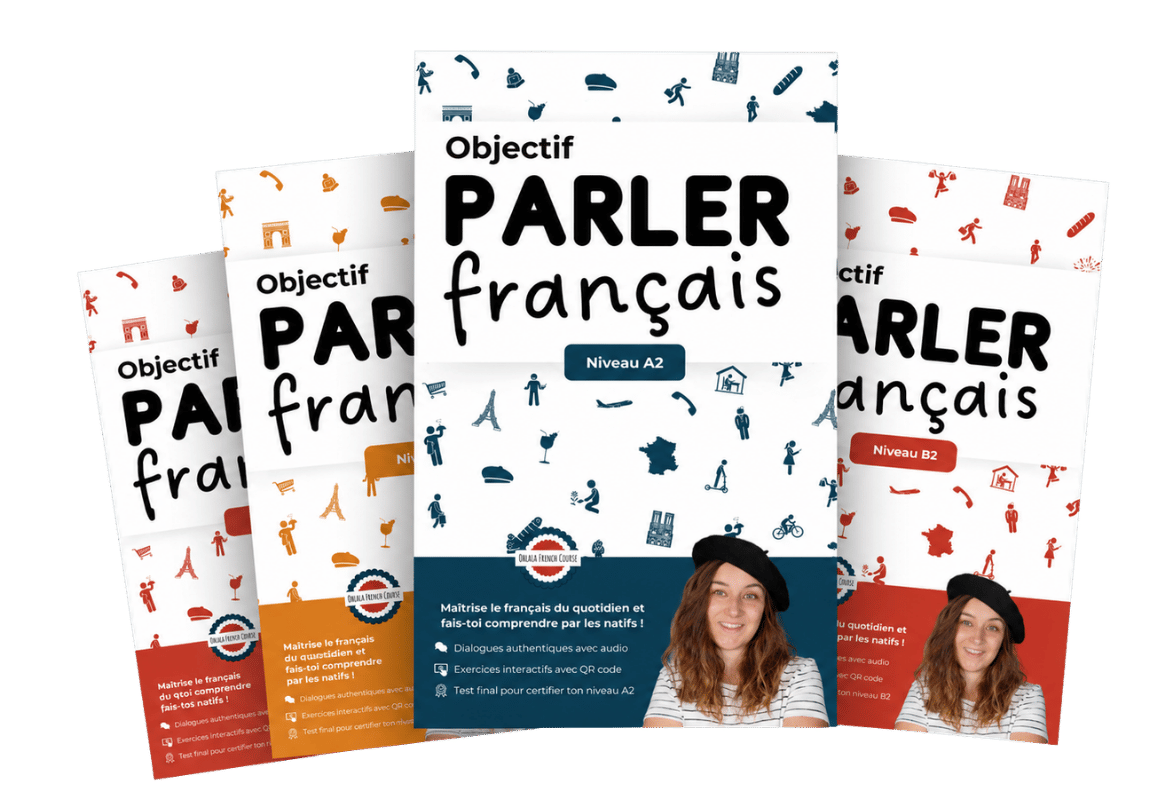
Recognizing “ça y est” in a list is a first step. Understanding it in a dialogue and using it at the right moment is another. To continue practicing in context, my Objectif : Parler français books offer realistic dialogues and audio recorded by native speakers.
Choose your level: A2, B1, B2 or C1. Read a dialogue, listen to the audio, then adapt a few sentences to your own life. This brings vocabulary, listening comprehension and pronunciation together.
Explore the Objectif : Parler français books →
3. Organize your speech and follow the conversation
21. Au fait
Pronunciation : [o fɛt]
You introduce a new topic or a question that has just occurred to you. It is similar to “by the way”.
Example:
Au fait, tu as réservé le restaurant ?
By the way, have you booked the restaurant?
Remember: In this expression, the t in “fait” is pronounced. “Au” is pronounced [o].
22. En fait
Pronunciation : [ɑ̃ fɛt]
You correct, explain or clarify some information. Do not confuse it with “au fait”, which introduces a new topic.
Example:
— Tu habites à Paris ?
— En fait, j’habite juste à côté, à Montreuil.
— Do you live in Paris?
— Actually, I live just outside it, in Montreuil.
Remember: “En” contains the nasal vowel [ɑ̃], unlike “au”.
23. Du coup
Pronunciation : [dy ku]
You introduce a consequence, much like “so” or “as a result”. It is very common in spoken French, but avoid adding it to every sentence.
Example:
Le train était annulé. Du coup, j’ai pris le bus.
The train was cancelled. So I took the bus.
Remember: The u in “du” [y] differs from the ou in “coup” [u]. The final p is silent.
24. Quand même
Pronunciation : [kɑ̃ mɛm]
You express contrast, surprise or emphasis. “Je sors quand même” means you are going out despite an obstacle; “C’est quand même très cher !” emphasizes the price.
Example:
Il pleut, mais je vais sortir quand même.
It’s raining, but I’m going out anyway.
Remember: The d in “quand” is silent before “même”. Intonation helps convey the nuance.
25. Bref
Pronunciation : [bʁɛf]
You summarize an explanation or get back to the main point. Depending on your tone, it can also signal that you want to move on.
Example:
J’ai raté le bus, puis mon téléphone est tombé en panne… Bref, je suis arrivé en retard.
I missed the bus, then my phone stopped working… In short, I was late.
Remember: The final f is pronounced.
26. Je vois
Pronunciation : [ʒə vwa]
In conversation, you often mean that you understand what the other person is saying, rather than that you literally see something.
Example:
— Le problème, c’est que nous n’avons pas assez de temps.
— Oui, je vois.
— The problem is that we don’t have enough time.
— Yes, I see.
Remember: The letters oi are pronounced [wa]; the final s is silent.
27. Je m’en doutais
Pronunciation : [ʒə mɑ̃ dutɛ]
You already suspected that something was probably true. The news confirms your intuition.
Example:
— Léa va quitter l’entreprise.
— Ah, je m’en doutais.
— Léa is going to leave the company.
— Ah, I suspected as much.
Remember: In “m’en”, m is the elided form of “me”: it is not a liaison.
28. C’est dommage
Pronunciation : [sɛ dɔmaʒ]
You express disappointment or sympathy, acknowledging that the situation could have been better.
Example:
— Je ne pourrai pas venir à ta fête.
— Ah, c’est dommage.
— I won’t be able to come to your party.
— Oh, that’s a shame.
Remember: The end of “dommage” contains [ʒ], the sound in “je”.
29. Ça ira
Pronunciation : [sa iʁa]
You reassure someone that things will be fine. In “Non merci, ça ira”, you can also mean that you already have enough.
Example:
— Tu penses pouvoir finir aujourd’hui ?
— Oui, ça ira.
— Do you think you can finish today?
— Yes, it’ll be fine.
Remember: At a restaurant, “Non merci, ça ira” can politely decline anything more.
30. Je me débrouille
Pronunciation : [ʒə mə debʁuj]
You manage a situation using the knowledge or resources you have. For a learner, it is a way of saying you can communicate without claiming to be bilingual.
Example:
— Tu parles français ?
— Je ne suis pas bilingue, mais je me débrouille.
— Do you speak French?
— I’m not bilingual, but I get by.
Remember: “Débrouille” rhymes with “grenouille”: the ending is pronounced [uj].
“Au fait” or “en fait”: the difference in one sentence
Au fait introduces a topic: “Au fait, tu viens demain ?” — By the way, are you coming tomorrow? En fait clarifies or corrects: “En fait, je viendrai vendredi.” — Actually, I’ll come on Friday. Ask yourself whether you are opening a new topic or adjusting information already given.
Your challenge: five expressions, five personal sentences
Do not try to memorize all thirty expressions at once. Choose five that fit your conversations: one to accept a suggestion, one to react to news, one to ask for something, one to connect your ideas and one to describe your French.
Write a personal sentence with each one, then say it aloud. For example: “Je ne comprends pas tous les films en français, mais je me débrouille dans les commerces.” — I don’t understand every French film, but I get by in shops. Try recalling your sentences the next day without looking, then use one in a real exchange.
More natural French, one expression at a time
You do not need a complicated word to take part in a conversation. “Ça me va” lets you accept a time; “Je vois” shows you understand; “Je me débrouille” describes what you can already do. What matters is matching the phrase to the situation and the tone you want to convey.
For more dialogues suited to your level and native-speaker audio, explore the Objectif : Parler français books. The goal is not to recite a list: it is to recognize these expressions and use them when you need them.