30 phrases to speak like a French person at a restaurant
Reading time: 15 min
You know how to speak French.
You know grammar. You have vocabulary. You can have a normal conversation.
And yet.
When you enter a restaurant in France, there is that moment…
You look at the menu.
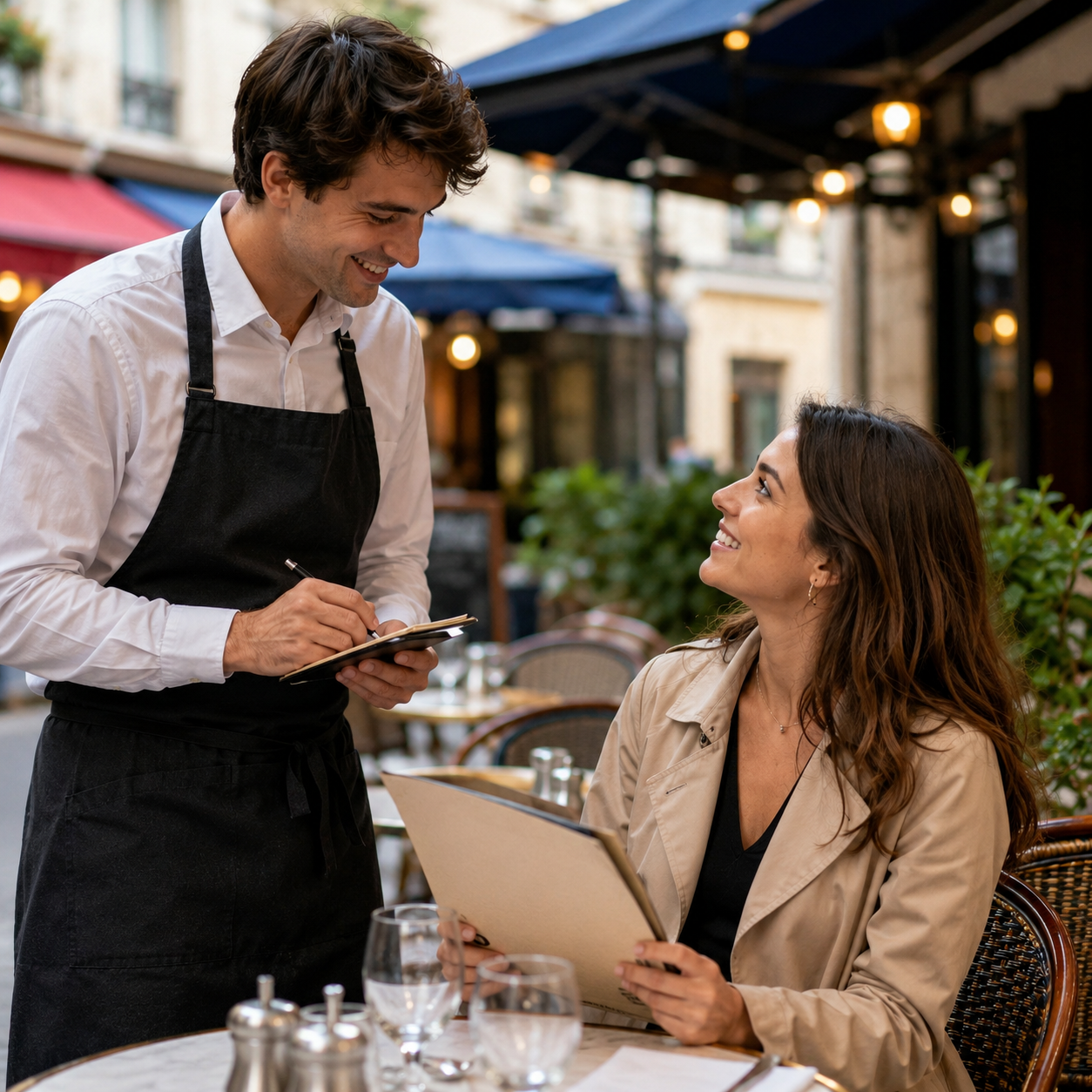
The waiter comes over.
And your brain freezes.
Not because you don’t understand the words.
But because you don’t know HOW French people really speak at a restaurant.
The real problem:
Textbooks often teach you correct French… but not natural French.
And at a restaurant, French people always use the same short, simple and fast phrases.
STEP 1: Arriving and asking for a table
Your first contact with the waiter.
This is where everything starts.
1. “Bonjour ! On est deux.” (Hi! There are two of us.)
2. “Vous avez une table en terrasse ?” (Do you have a table on the terrace / outside?)
3. “On peut se mettre là ?” (Can we sit there?)
4. “C’est possible d’avoir un coin un peu tranquille ?” (Is it possible to have a quieter corner?)
Do you notice something?
The phrases are very short.
Very simple.
Very natural.
The French reflex:
At a restaurant, French people simplify their phrases a lot.
“On est deux.”
You don’t need a long, overly polite sentence every time.
STEP 2: Reading the menu and asking questions
The waiter brings you the menu.
And sometimes… you don’t understand everything.
Good news: even French people ask for explanations.
5. “C’est quoi exactement, le [plat] ?” (What exactly is the [dish]?)
6. “Il y a quoi dedans ?” (What’s in it?)
7. “C’est copieux ?” (Is it filling / a generous portion?)
8. “Vous me conseillez quoi ?” (What do you recommend?)
9. “C’est quoi le plat du jour ?” (What’s the dish of the day?)
The important word here:
copieux.
You will hear it often at restaurants.
It means that a dish is generous and filling.
STEP 3: Ordering naturally
The waiter comes over.
And asks you:
“Vous avez choisi ?”
Three words.
Said very quickly.
And many learners panic here.
Here are the most natural answers.
10. “Oui ! Je vais prendre le [plat].” (Yes! I’ll have the [dish].)
11. “Pour moi, ce sera le [plat].” (For me, it’ll be the [dish].)
12. “La même chose pour moi.” (The same for me.)
13. “Et en dessert, on verra après.” (And for dessert, we’ll see later.)
14. “Sans [ingrédient], c’est possible ?” (Without [ingredient], is that possible?)
15. “Avec les frites ou la salade ?” (Does it come with fries or salad?)
16. “Ça vient avec quoi ?” (What does it come with?)
The very important detail:
French people mostly say:
“Je vais prendre…”
Not “je voudrais” in most everyday restaurants.
STEP 4: During the meal
The dishes arrive.
And now, you need to handle the small natural interactions.
17. “Excusez-moi, on pourrait avoir du pain ?” (Excuse me, could we have some bread?)
18. “On pourrait avoir une carafe d’eau, s’il vous plaît ?” (Could we have a jug of tap water, please?)
19. “C’est super bon !” (It’s really good!)
20. “C’est un peu froid, vous pouvez le réchauffer ?” (It’s a little cold, could you heat it up?)
21. “Excusez-moi, c’est pas ce que j’avais commandé.” (Excuse me, this isn’t what I ordered.)
22. “On pourrait avoir des serviettes en plus ?” (Could we have some extra napkins?)
The magic phrase:
“Une carafe d’eau”
In France, it means free tap water.
If you simply ask for “de l’eau”, you may receive a paid bottle of water.
STEP 5: Dessert and the bill
The meal is coming to an end.
And this is often when learners start feeling stressed again.
Because you need to react quickly.
23. “On va prendre un dessert, finalement.” (We’ll have a dessert after all.)
24. “Juste un café pour moi.” (Just a coffee for me.)
25. “L’addition, s’il vous plaît.” (The bill, please.)
26. “On peut payer par carte ?” (Can we pay by card?)
27. “On peut avoir des tickets séparés ?” (Can we have separate bills?)
28. “On va faire moitié-moitié.” (We’ll split it fifty-fifty.)
A small important cultural detail:
In France, the waiter almost never brings you the bill automatically.
You have to ask for it.
Otherwise, you may stay seated for a very long time.
STEP 6: The phrases that change everything
29. “Vous pouvez transmettre mes compliments au chef ?” (Could you pass my compliments on to the chef?)
30. “On reviendra !” (We’ll come back!)
These small phrases completely change the atmosphere.
They show that you also understand French restaurant culture.
The real problem: knowing the phrases is not enough
You can memorize these 30 phrases.
But in real life, the waiter will speak fast.
Very fast.
And without subtitles.
Your brain has to understand and answer immediately.
The difference between knowing French and living French:
Reading a phrase in an article is easy.
Understanding it at real speed and answering naturally is something else.
Do you want to finally dare to speak French in real life?
That is exactly why I created the free challenge:
30 days to speak French with confidence
The goal is not to give you even more grammar or even more theory.
The goal is to change your relationship with French.
For 30 days, you receive a short and simple email every morning with:
- a concrete tip,
- a small exercise,
- an immediate action to apply.
A few minutes a day are enough to start:
- speaking more naturally,
- understanding your blocks better,
- improving your pronunciation,
- building confidence when you speak French.
Why this challenge is different:
I gathered the best advice I developed after teaching more than 1000 students.
Not textbook French.
Not rules that are impossible to remember.
Real living French to help you finally be yourself and feel confident in French.
Ready to speak French with more confidence?
Join the free challenge “30 days to speak French with confidence”.
One email per day.
Concrete advice.
Small, simple actions that can truly change the way you speak French.
→ Join the free challengeYou don’t need to speak perfectly to enjoy a restaurant in France.
You just need to start practicing real spoken French.