From blocked to fluent: why you understand French but can’t speak it
Reading time: 12 min
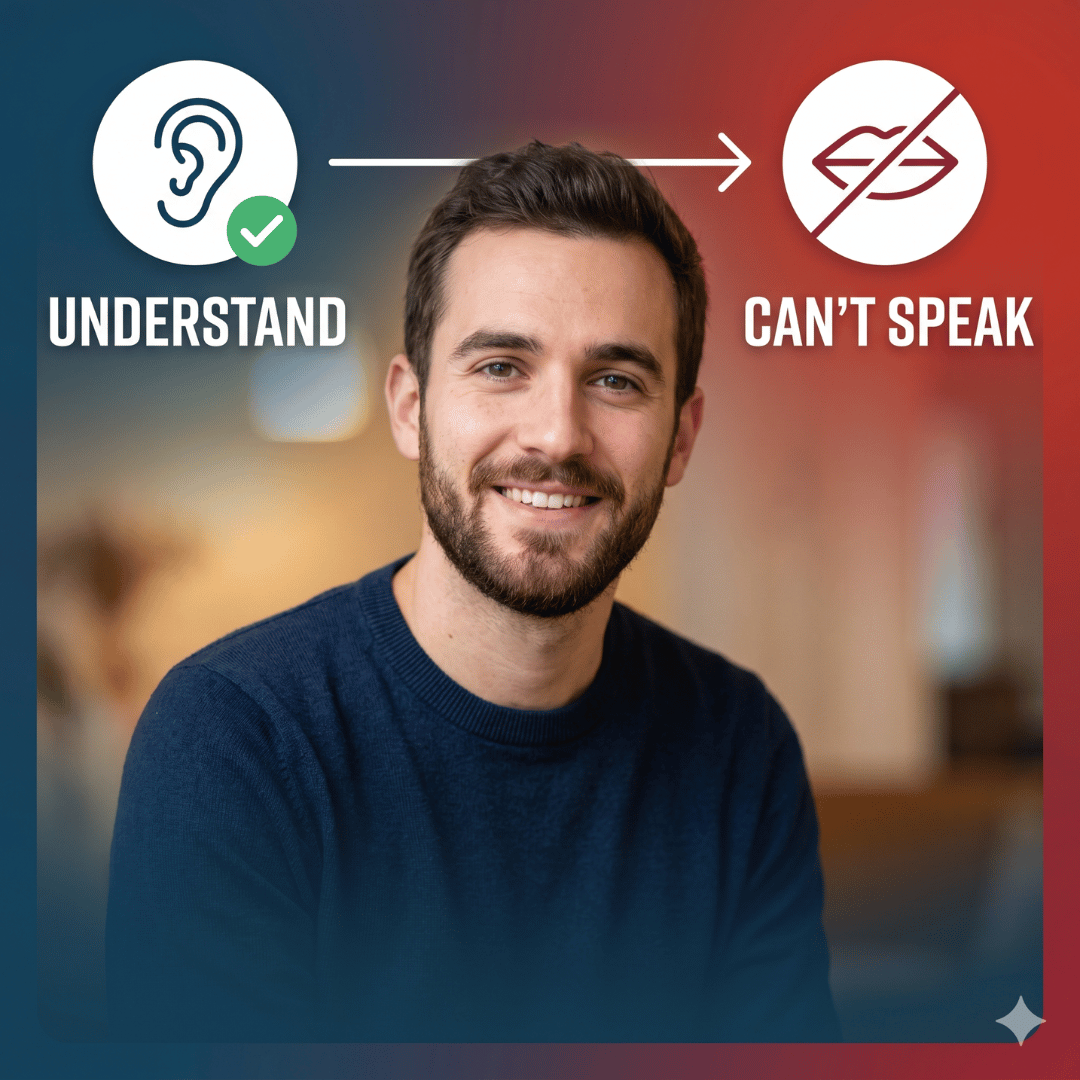
You understand French.
You watch videos in French. You understand podcasts. You read articles. Maybe you even read novels in French.
And yet.
The moment you have to open your mouth — the moment a French person asks you a question and waits for your answer — everything goes blank. Completely.
The words are there, somewhere in your head. But they refuse to come out.
If this happens to you, you are not alone.
It’s probably the number one problem for intermediate and advanced French learners.
And the good news? There’s a very clear explanation. And a solution that actually works.
The symptom: why you freeze
You’re sitting at a table with French people. They’re talking to each other. You understand the topic. You understand the jokes — well, most of them. You follow the conversation.
And in your head, you think:
“Oh, I have something to say about that.”
You have an opinion. You even have a story.
But by the time you build the sentence in your head… the topic has changed.
Or you finally start speaking. You open your mouth. And what comes out is slow. Hesitant. Full of gaps. “Umm…” “How do you say…?”
And the sentence that sounded perfect in your head comes out broken.
The real frustration:
You know the words.
You understand what people are saying.
But your mouth doesn’t follow your brain.
Understanding ≠ speaking
The real reason: your brain has two systems
Your brain does not process a language the same way when you understand it and when you speak it.
It uses two different systems.
System 1: recognition
This is passive mode.
When you hear a word, your brain recognizes it:
“Oh yes, I know that word.”
This is what happens when you:
- watch a video in French,
- listen to a podcast,
- read an article,
- understand a conversation.
It’s fast. It’s efficient. And it’s usually much easier than speaking.
System 2: active recall
This is production mode.
Here, your brain has to find the word by itself, without help, without subtitles, without obvious context.
It has to produce it at the right moment, in the right order, with the correct conjugation.
And that is much harder.
The thing nobody tells you:
Active recall is much harder than recognition.
You can recognize a word easily, but still fail to produce it when you need it.
The simple analogy: recognizing vs reproducing
Imagine I show you a photo of someone you know.
You recognize them immediately:
“Yes, that’s Pierre.”
Easy.
Now I give you a pencil and a blank sheet of paper.
And I tell you:
“Draw Pierre’s face from memory.”
Much harder, right?
And yet, it’s the same face.
For a language, it’s the same thing.
Understanding French is recognizing a face.
Speaking French is drawing that face from memory.
These are two completely different skills.
The 3 mistakes that make the gap bigger
1. Too much passive consumption
You watch YouTube videos. You listen to podcasts. You read articles. You do exercises on apps.
And you feel like you’re improving.
Because you understand more and more.
But understanding is recognition mode.
If you spend all your time recognizing French, but never producing it, you create a huge imbalance.
The result:
You understand a lot.
But you can barely say anything spontaneously.
2. Fear of making mistakes
Fear of mistakes is one of the biggest traps.
You want to speak correctly. You want to avoid mistakes. You want to sound intelligent.
So you wait.
You prepare your sentence.
You mentally check everything.
And meanwhile, the conversation keeps moving.
The more afraid you are of making mistakes, the less you speak.
And the less you speak, the harder speaking becomes.
The rule:
Communication before perfection.
Always.
3. Not enough regular practice
Speaking French once a week for one hour is not enough to create automatic reflexes.
Active recall is a muscle.
And like every muscle, it needs regular training.
Not huge sessions once in a while.
But a little bit, often.
Frequency is what creates fluency.
What changes when you practice regularly
When you practice speaking regularly, your vocabulary does not necessarily change much at first.
Your grammar doesn’t either.
But something essential changes:
the speed at which your brain finds words.
Words come out faster.
Sentences become more natural.
You translate less mentally.
You dare to answer even if it’s not perfect.
Real progress is not just knowing more French.
It’s being able to produce the French you already know more quickly.
The only solution that truly works
You understand French. You have vocabulary. You know grammar. You’ve spent hours, maybe years, studying.
But when a French person talks to you and waits for your answer, your brain loads like a Windows update.
It’s not a knowledge problem.
It’s a practice problem.
And the only way to solve this problem is to speak.
- Regularly.
- With real people.
- In real conversations.
- With feedback.
- Without waiting to be perfect.
Realistic results: week by week
Week 1: You feel nervous. Normal. But your pauses start getting shorter.
Week 2: Answers come out more naturally. You translate a little less.
Week 3: A full sentence comes out without translation. Just in French.
Week 4: You speak with less stress. People understand you. You participate more.
After 6 to 8 weeks: Sometimes you even forget you’re making an effort. You just speak. Period.
After 3 to 4 months: Other people notice your French is much more fluent.
Why Ohlala French School can help you
That’s exactly why I created Ohlala French School.
Not another course to watch alone.
A place where you speak.
Ohlala French School is:
- 8 conversation sessions per week,
- small groups,
- teachers who guide you,
- direct feedback,
- a space where it’s OK to make mistakes.
Think of it like a gym for your French.
You come, you practice, and week after week, the words come faster.
Sentences come out more naturally.
The hesitation fades away.
And one day, without even realizing it, you find yourself speaking French without translating in your head.
Do you want to go from blocked to fluent?
Try Ohlala French School free for 7 days.
Come to one conversation.
Just one.
And see what it feels like to speak instead of only understand.
→ Start my free trialSummary
You understand French, but you freeze when you speak?
It’s not because you’re bad at languages.
It’s not necessarily because you lack vocabulary.
It’s because understanding and speaking are two different skills.
The solution is regular speaking practice.
With real people. With feedback. With repetition.
In just a few weeks, you can already feel a real difference.
And it starts with a single conversation.