Speak French in Meetings Without Freezing
Reading time: 11 min
The meeting started twenty minutes ago.
Everyone is talking. Your boss is asking questions. Your colleagues are answering. Decisions are being made.
Then, suddenly, it’s your turn.
Your boss turns to you:
“Et toi, qu’en penses-tu ?”
And then… you freeze.
You know what you want to say. You have a good idea. You are competent.
But in French, in that exact moment, the words don’t come out.
There is an awkward silence. Three seconds. Five seconds. Maybe more.
The meeting moves on.
And you feel invisible.
If this happens to you, the problem is not your intelligence.
It’s not necessarily your French level either.
The real problem is that you haven’t trained your brain yet to speak French under professional pressure.
Why do you freeze specifically in meetings?
Speaking French at a restaurant, at the bakery, or with a neighbor is one thing.
Speaking French in a professional meeting is another.
In a meeting, there are three pressures happening at the same time:
- you need to answer quickly,
- you need to sound professional,
- you are afraid of being judged.
And when your brain feels too much pressure, it often does something very simple:
it freezes.
You start translating mentally. You check the grammar. You search for the right word. You want to avoid mistakes.
And while all of that is happening, the conversation moves on.
The real problem:
You don’t freeze because you have nothing to say.
You freeze because your brain has to handle too many things at the same time:
idea → translation → grammar → professional tone → spoken answer
That’s far too heavy in real time.
The 4 real reasons you freeze
1. You haven’t practiced French enough in a professional context
You may be able to talk about your day, order a coffee, or tell someone about your weekend.
But a meeting is not the same context.
You need to know how to give an opinion, add nuance, interrupt politely, explain a problem, and suggest a solution.
If you’ve never trained yourself to do that in French, it’s normal to freeze.
2. You don’t have automatic phrases ready
In meetings, some structures come back all the time:
- “Je suis d’accord, mais…”
- “À mon avis, on devrait…”
- “Je ne suis pas sûr que ce soit la meilleure option.”
- “Avant de décider, il faudrait vérifier…”
If these phrases are not automatic, your brain has to build them from scratch.
And in a meeting, you don’t have time.
3. You want to speak perfectly
You might think:
“Si je parle en réunion, je dois parler sans erreur.”
But that’s false.
Your colleagues don’t expect you to speak like a native speaker.
They want to understand your ideas.
And often, a simple but clear sentence is better than a perfect sentence that never comes out.
4. You practice French, but not pressure
Watching a YouTube video, reading an article, or using an app is useful.
But it does not recreate the pressure of a meeting.
In a real meeting, someone is waiting for your answer.
Now.
And that exact pressure is what you need to learn to manage.
The mistakes that make the block worse
The first mistake is waiting until you feel “ready.”
You tell yourself:
“Je parlerai en réunion quand mon français sera meilleur.”
But it works the other way around.
Your professional French improves because you speak in professional contexts.
The second mistake is believing you need to learn more vocabulary before participating.
Of course, vocabulary helps.
But what you mostly need are reflexes.
Knowing how to say quickly:
- “Je peux ajouter quelque chose ?”
- “Je vois ce que tu veux dire.”
- “Je ne suis pas totalement d’accord.”
- “On peut faire le point rapidement ?”
These small phrases are what allow you to exist in the meeting.
The real shift:
You don’t need perfect French to speak in meetings.
You need French that is available quickly.
How to speak French in meetings without freezing
Prepare your phrases before the meeting:
Before a meeting, take five minutes.
Ask yourself:
- What might they ask me?
- What is my opinion?
- How can I say it simply in French?
The goal is not to memorize a speech.
The goal is to create paths that are already ready in your brain.
Use simple but professional phrases
You don’t need long sentences.
You can say:
“À mon avis, on devrait tester cette option.”
“Je suis d’accord sur le principe, mais j’ai une réserve.”
“Je pense qu’il faut clarifier ce point avant de décider.”
“Je peux revenir vers vous avec plus d’informations.”
Simple. Clear. Professional.
Speak even if it’s not perfect
Confidence does not come before speaking.
It comes because you speak.
At first, it will be imperfect.
But every time you speak, your brain learns:
“Je peux le faire. Je peux parler français dans un contexte professionnel.”
Practice with real-time pressure
This is the most important point.
You need to train in situations where someone listens to you and waits for your answer.
Not an app.
Not a video.
A real person.
That is what transforms your passive French into active French.
The formula that works:
To stop freezing in meetings, you need 3 things:
1. Regular practice of professional French
Not just general French, but work topics, meetings, decisions, and projects.
2. Immediate feedback
You need to know what sounds natural, what sounds awkward, and how to phrase things better.
3. Real-time pressure
Someone asks you a question. You answer. Your brain learns to react.
Why can Ohlala French School help you?
Most methods give you content.
More videos. More vocabulary. More exercises.
But if your problem is speaking in meetings, you don’t only need content.
You need real speaking practice.
At Ohlala French School, you can practice regularly with native teachers, in small groups, around useful and concrete topics.
- 8 real conversations per week
- Groups of a similar level
- Concrete conversation topics
- Direct feedback
- Real spoken French practice
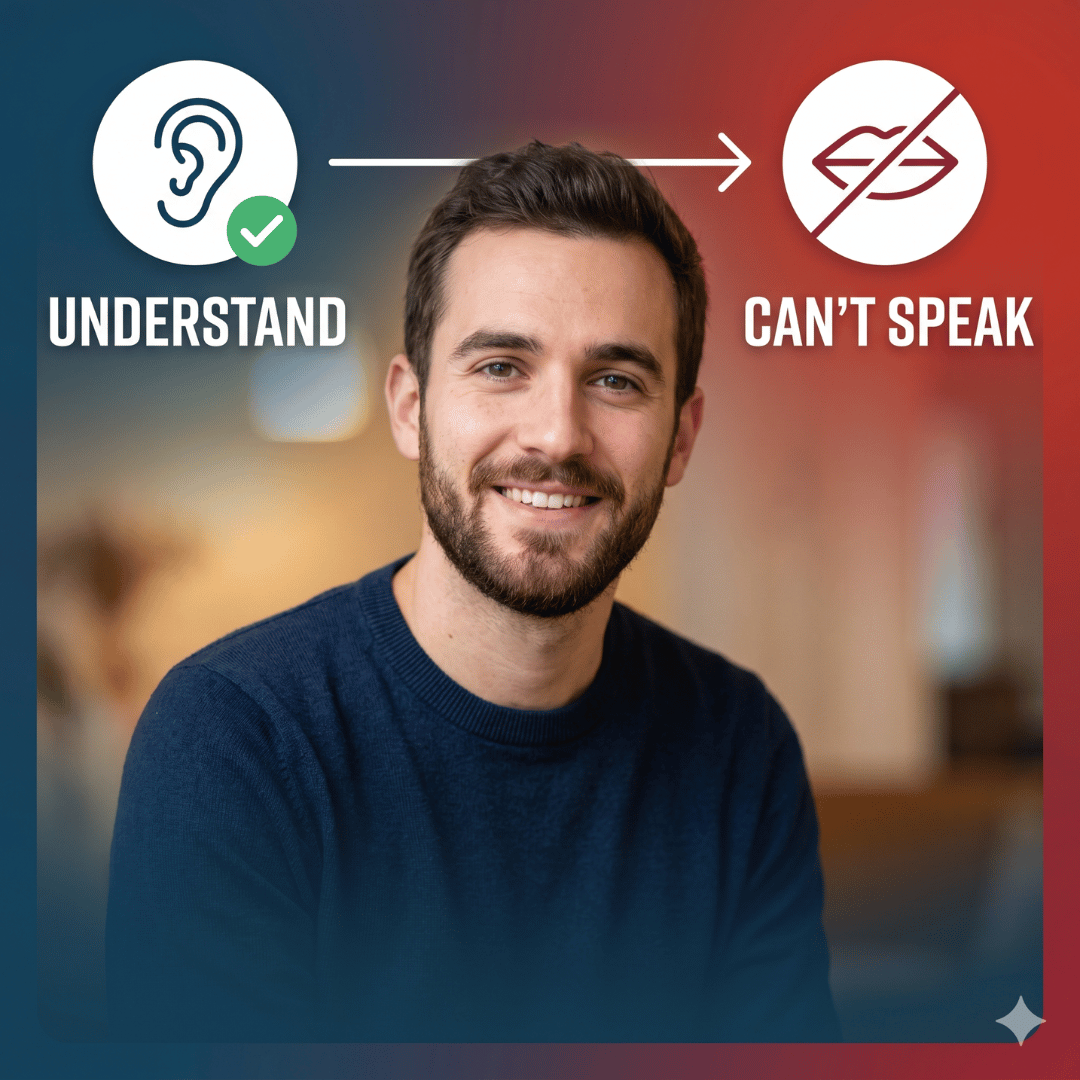
You don’t only learn to understand French.
You learn to answer.
And that is exactly what you need in meetings.
How long does it take?
Honestly, you can feel a difference quite quickly.
After a few weeks of regular practice, many learners notice:
- less panic when someone asks them a question,
- faster answers,
- less mental translation,
- more participation in meetings,
- more professional confidence.
Not because their French becomes perfect.
But because they get used to using their French in real time.
Ready to speak French in meetings without freezing?
Try Ohlala French School free for 7 days.
Real conversations.
Real teachers.
Real spoken French.
→ Start my free trialFrequently asked questions:
I’m already B2 or C1. Is this useful for me?
Yes. Freezing in meetings is not only a level problem. It is often a problem of pressure, speed, and lack of professional speaking practice.
I make a lot of mistakes. Is that a problem?
No. The most important thing is being understood and participating. Mistakes are corrected with feedback and practice.
I don’t have many 100% French meetings. Does this still help?
Yes. Even in bilingual meetings, you need to be able to jump in quickly in French when the situation requires it.
What if I’m afraid to speak?
That’s normal. But fear decreases when your brain understands that you can answer, even imperfectly, and that people understand you.
You don’t need to wait until you are perfect to speak in meetings.
You just need to train yourself to answer.