Talking About Summer in French: 50 Useful Words and Expressions
Reading time: 14 min
Summer is arriving in France.
And suddenly, every conversation changes.
At the café, people talk about the heat.
At work, everyone talks about vacation.
In the street, people talk about la canicule, terraces, holiday departures, the beach, and traffic jams.
And you, what do you say?
“Il fait très chaud” ?
It’s correct.
But it’s basic.
The real problem:
French people do not talk about summer the way textbooks do.
They use very natural, vivid, and sometimes slightly dramatic expressions.
And if you don’t know them, you can quickly feel out of the loop.
Today, I’m giving you 50 essential words and expressions to talk about summer in French.
Not school vocabulary.
Real, living French.
Why is summer vocabulary important?
Summer in France is not just a season.
It’s a real conversation topic.
As soon as it starts getting hot, French people talk about:
- vacation,
- the weather,
- the beach,
- terraces,
- barbecues,
- traffic jams,
- and of course… the heat.
The French reflex:
In summer, French people comment on everything.
The heat.
The sun.
Vacation.
The terrace.
And often with a lot of exaggeration.
So if you want to take part naturally in conversations in France, you need to know these expressions.
Let’s begin.
50 words and expressions to talk about summer in French
I’ve organized them by context.
Because that’s how your brain will really remember them.
Weather and heat
This is THE big summer topic.
When it’s hot in France, everyone talks about it.
1. “Il fait une de ces chaleurs !” (It’s so hot!)
Not just “il fait chaud”.
“Il fait une de ces chaleurs !” is more expressive, more dramatic, more French.
2. “C’est une vraie fournaise.” (It’s a real furnace.)
Use it when it is really, really hot.
Une fournaise is like a huge oven.
3. “On crève de chaud.” (We’re dying of heat.)
It’s exaggerated.
It’s dramatic.
It’s very French.
4. “C’est suffocant.” (It’s suffocating.)
Use it when it’s not just hot, but when the air feels heavy and hard to bear.
5. “Les températures montent.” (Temperatures are rising.)
A very common expression in the media and in conversations.
6. “C’est la canicule.” (It’s a heat wave.)
La canicule is when the heat becomes truly extreme.
7. “Le soleil tape.” (The sun is beating down.)
We say this when the sun is strong, intense, almost aggressive.
8. “C’est dégueulasse comme temps.” (The weather is disgusting.)
Very informal.
French people use it when the weather is really unpleasant, even if it’s sunny but too hot.
Remember this:
French people love to dramatize the heat.
Saying “il fait chaud” is correct.
But saying “on crève de chaud” sounds much more natural.
Vacation and summer plans
In June and July, one question comes back all the time:
“Tu pars où cet été ?”
9. “Où est-ce que tu vas passer l’été ?” (Where are you spending the summer?)
Passer l’été means spending the summer period somewhere.
10. “Je vais en vacances début juillet.” (I’m going on vacation at the beginning of July.)
In French, we say en vacances, always plural.
11. “On prend trois semaines.” (We’re taking three weeks.)
Very natural when talking about how long your vacation is.
12. “C’est encore loin, les vacances ?” (Is it still a while until vacation?)
A typical sentence when everyone is tired before summer.
13. “Les départs en vacances commencent.” (The holiday departures are beginning.)
An expression you often hear in the media.
14. “C’est la période creuse.” (It’s the slow period.)
When everyone is on vacation and work slows down.
15. “Je fais le pont.” (I’m taking a long weekend.)
Faire le pont means taking a day off between a public holiday and the weekend.
16. “Pas de chance, j’ai raté les soldes.” (Bad luck, I missed the sales.)
The summer sales are very important in France.
The beach and seaside activities
If you go to the seaside, these expressions will come up everywhere.
17. “On va à la plage demain.” (We’re going to the beach tomorrow.)
Simple, but essential.
18. “C’est bondé.” (It’s packed.)
Bondé means there are really a lot of people.
19. “L’eau est bonne.” (The water is nice.)
We don’t always say “l’eau est chaude”.
We often say “l’eau est bonne” to mean the water is pleasant for swimming.
20. “Je me baigne.” (I’m going swimming.)
Se baigner is very common when talking about going into the water.
21. “Je fais du surf.” (I’m surfing.)
You can also say: je fais du paddle, je fais du kayak.
22. “On fait un barbecue.” (We’re having a barbecue.)
A classic summer activity.
23. “C’est trop fort, le soleil.” (The sun is too intense.)
Here, fort means intense.
24. “Je me suis pris un coup de soleil.” (I got sunburned.)
Un coup de soleil is a sunburn.
Summer clothes and accessories
When it’s hot, clothes also become a topic of conversation.
25. “Je mets mes tongs.” (I’m putting on my flip-flops.)
Careful: in French, des tongs means flip-flops.
26. “J’oublie jamais la crème solaire.” (I never forget sunscreen.)
La crème solaire is essential in summer.
27. “Je prends mes lunettes de soleil.” (I’m taking my sunglasses.)
Very useful in everyday life.
28. “C’est mieux en short.” (It’s better in shorts.)
Simple and natural.
29. “Je mets un chapeau.” (I’m wearing a hat.)
Small correction: we write je mets with an s.
30. “On va en robe légère.” (We’ll wear light dresses.)
Une robe légère is a thin, comfortable dress for hot weather.
Restaurants and terraces
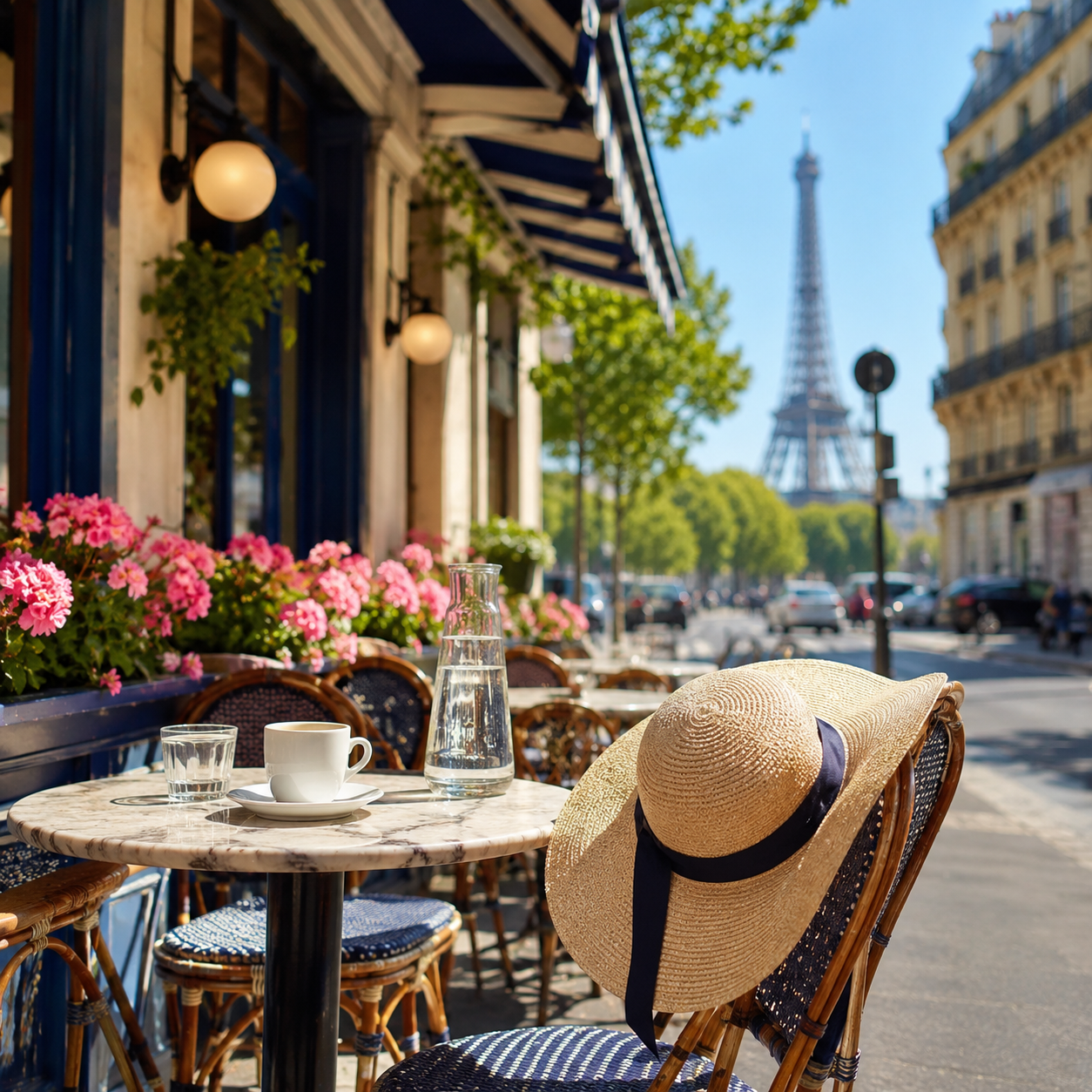
Summer in France is also terrace season.
La terrasse, c’est sacré.
As soon as there is sun, French people want to sit outside.
Even if it’s not that warm.
31. “On peut s’asseoir en terrasse ?” (Can we sit on the terrace?)
An essential expression in summer.
32. “Un verre frais, s’il vous plaît.” (A cold drink, please.)
Frais means cold or refreshing depending on the context.
33. “Je prends une menthe à l’eau.” (I’ll have a mint syrup with water.)
A very French and very summery drink.
34. “C’est mieux avec glaçons.” (It’s better with ice cubes.)
Les glaçons are ice cubes.
35. “Une salade composée, c’est parfait.” (A mixed salad is perfect.)
Une salade composée is a salad with several ingredients.
36. “On peut manger dehors ce soir ?” (Can we eat outside tonight?)
Very common as soon as the weather is nice.
Summer activities and leisure
To talk about your summer plans, these expressions are very useful.
37. “Je fais une promenade.” (I’m going for a walk.)
Une promenade is a relaxed walk.
38. “On fait un pique-nique.” (We’re having a picnic.)
A classic summer activity.
39. “Je lis un livre à la plage.” (I’m reading a book on the beach.)
Simple and very useful.
40. “On va faire du camping.” (We’re going camping.)
Very common when talking about vacation.
41. “Je fais une sieste.” (I’m taking a nap.)
A nap becomes very tempting when it’s hot.
42. “On explore la région.” (We’re exploring the region.)
Perfect for talking about vacation in France.
43. “Je visite les monuments.” (I’m visiting the monuments.)
Very useful for talking about tourism.
44. “On fait une excursion.” (We’re going on an excursion.)
Une excursion is often a day trip.
Feelings and reactions
Summer is not only about activities.
It’s also about sensations.
45. “J’ai trop chaud.” (I’m too hot.)
Careful: we say j’ai chaud, not je suis chaud.
46. “C’est épuisant.” (It’s exhausting.)
When the heat really tires you out.
47. “Je me sens bien.” (I feel good.)
To talk about a nice moment, a pleasant feeling.
48. “C’est stressant, les bouchons.” (Traffic jams are stressful.)
Les bouchons means traffic jams.
49. “Je rêve d’une piscine.” (I’m dreaming of a swimming pool.)
Very natural when it’s extremely hot.
50. “L’été, c’est le meilleur moment.” (Summer is the best time.)
Simple, natural, positive.
Now you can talk about summer
There you go.
50 words and expressions.
Real ones.
The ones French people really use in summer.
Now, when someone says:
“Il fait une chaleur !”
You understand.
And even better: you can answer.
That’s what speaking French means.
Not just knowing words.
But being able to take part in real conversations.
The next step: practice these words
As always, knowing these 50 words is not enough.
You need to hear them.
Repeat them.
Use them.
In real conversations.
Real progress:
It’s not when you read an expression and understand it.
It’s when you manage to use it naturally at the right moment.
And summer is the perfect time to practice.
Because these words will be everywhere around you.
On a café terrace.
At work.
At the beach.
In conversations with your neighbors.
Why can Ohlala French School help you?
At Ohlala French School, you can practice this vocabulary in real conversations.
Not just read a list.
Not just repeat alone in your head.
But speak with native teachers, receive feedback, and use French in real-life situations.
You can talk about:
- the weather,
- vacation,
- the beach,
- restaurants,
- summer activities,
- everyday conversations.
Ready to speak French naturally this summer?
Try Ohlala French School for free for 7 days.
Real conversations.
Native teachers.
Feedback.
Real spoken French.
→ Start my free trialRecap
8 words and expressions to talk about the weather and the heat.
8 words and expressions to talk about vacation.
8 words and expressions to talk about the beach.
6 words and expressions to talk about summer clothes.
6 words and expressions to talk about restaurants and terraces.
8 words and expressions to talk about summer activities.
6 words and expressions to talk about your feelings and reactions.
Learn them.
Practice them.
And enjoy a better summer in French.