50 Ways to Answer the Most Common Questions in French
Learn 50 natural answers to 10 common French questions, with clear explanations, English meanings, two mini-tests and examples to keep conversations going.
When a French speaker asks “Ça va ?”, “Tu viens d’où ?” or “Qu’est-ce que tu en penses ?”, do you always give the same very short answer?
Those answers may be correct, but they can bring the conversation to a stop.
This article covers 10 common French questions with 5 natural answers each: 50 useful phrases to introduce yourself, accept, decline, share your opinion and keep talking.
You do not need to memorise all 50 answers today. Pick one or two per question, say them aloud and adapt them to your own life.
After questions 3 and 7, try a mini-test. Question 10 shows you how to turn down a request politely.
Contents
- Ça va ?
- Tu t’appelles comment ?
- Tu viens d’où ?
- Tu habites où ?
- Qu’est-ce que tu fais dans la vie ?
- Depuis combien de temps tu apprends le français ?
- Qu’est-ce que tu fais ce week-end ?
- Tu veux… ?
- Qu’est-ce que tu en penses ?
- Tu peux… ?
1. « Ça va ? »
Many learners automatically say “Ça va bien, merci, et toi ?” This is correct, but here are five other natural options.
1. « Ça va très bien, merci. »
I’m doing very well, thank you.
A simple, positive answer that works in almost any situation.
2. « Oui, ça va, et toi ? »
Yes, I’m fine. How about you?
Very common among friends or colleagues. Here, oui simply reinforces the answer.
3. « Ça peut aller. »
I’m doing okay.
Things are not perfect, but they are manageable. This is less enthusiastic than ça va très bien.
4. « Je suis un peu fatigué aujourd’hui. »
I’m a little tired today.
You share a real detail, giving the other person something to respond to. A woman writes fatiguée.
5. « Ça va beaucoup mieux. »
I’m doing much better.
Use this when the person knows you were ill, stressed or going through a difficult time.
2. « Tu t’appelles comment ? »
Five ways to answer or introduce yourself.
6. « Je m’appelle Maria. »
My name is Maria.
The standard answer: simple and always correct.
7. « Moi, c’est Maria. »
I’m Maria.
A relaxed way to introduce yourself in conversation.
8. « Maria, enchantée. »
Maria. Nice to meet you.
A short introduction. A man writes enchanté; a woman writes enchantée. They sound the same.
9. « Je m’appelle Maria, mais tout le monde m’appelle Mari. »
My name is Maria, but everyone calls me Mari.
Useful if you go by a shortened name or a nickname.
10. « Mon prénom, c’est Maria. Et toi ? »
My first name is Maria. What’s yours?
A natural structure that immediately keeps the conversation going.
3. « Tu viens d’où ? »
This can refer to your country, your hometown or the place you have just left. Context matters.
11. « Je viens du Brésil. »
I’m from Brazil.
Use du with masculine country names beginning with a consonant: du Brésil, du Canada, du Japon.
12. « Je viens de Colombie. »
I’m from Colombia.
Many feminine country names take de or d’: de Colombie, de France, d’Italie.
13. « Je suis originaire de Montréal. »
I’m originally from Montreal.
A slightly more formal way to explain where you originally come from.
14. « Je suis né en Argentine, mais j’habite en Espagne. »
I was born in Argentina, but I live in Spain.
Useful when your birthplace and current home are in different countries. A woman writes née.
15. « Je viens de Lyon, mais j’ai grandi à Marseille. »
I’m from Lyon, but I grew up in Marseille.
Grandir quelque part describes where you spent your childhood.
Mini-test 1
Choose your answer before reading the suggestion.
Someone asks “Ça va ?” You had a difficult week, but you feel better today.
Suggested answer: « Ça va beaucoup mieux, merci. »
Someone asks your name at an informal party.
Suggested answer: « Moi, c’est Maria. Et toi ? »
You were born in Mexico, but you currently live in France.
Suggested answer: « Je suis né au Mexique, mais j’habite en France. »
4. « Tu habites où ? »
Five answers, from a simple location to a more detailed response.
16. « J’habite à Paris. »
I live in Paris.
With a city, generally use the preposition à.
17. « J’habite en banlieue parisienne. »
I live in the Paris suburbs.
You live near Paris, but not in the city itself.
18. « J’habite près de Bordeaux. »
I live near Bordeaux.
Useful if your own town is small or not well known.
19. « Je vis dans le sud de la France. »
I live in the south of France.
Both vivre and habiter can be used in this context.
20. « J’habite ici depuis trois ans. »
I’ve lived here for three years.
This adds a length of time and invites a follow-up question. French uses the present tense because you still live here.
5. « Qu’est-ce que tu fais dans la vie ? »
This usually means: “What is your job or main activity?”
21. « Je suis ingénieur. »
I’m an engineer.
For a simple statement of your profession after être, French normally omits the indefinite article: je suis ingénieur.
22. « Je travaille dans le marketing. »
I work in marketing.
Use travailler dans to name your industry or field.
23. « Je travaille pour une entreprise française. »
I work for a French company.
Travailler pour introduces your employer or the kind of organisation you work for.
24. « Je suis à mon compte. »
I’m self-employed.
This expression means you work for yourself.
25. « En ce moment, je suis en reconversion professionnelle. »
At the moment, I’m changing careers.
You are moving into a different profession or field.
These answers are more than word-for-word translations. They are ready-to-use phrases you can bring into a conversation.
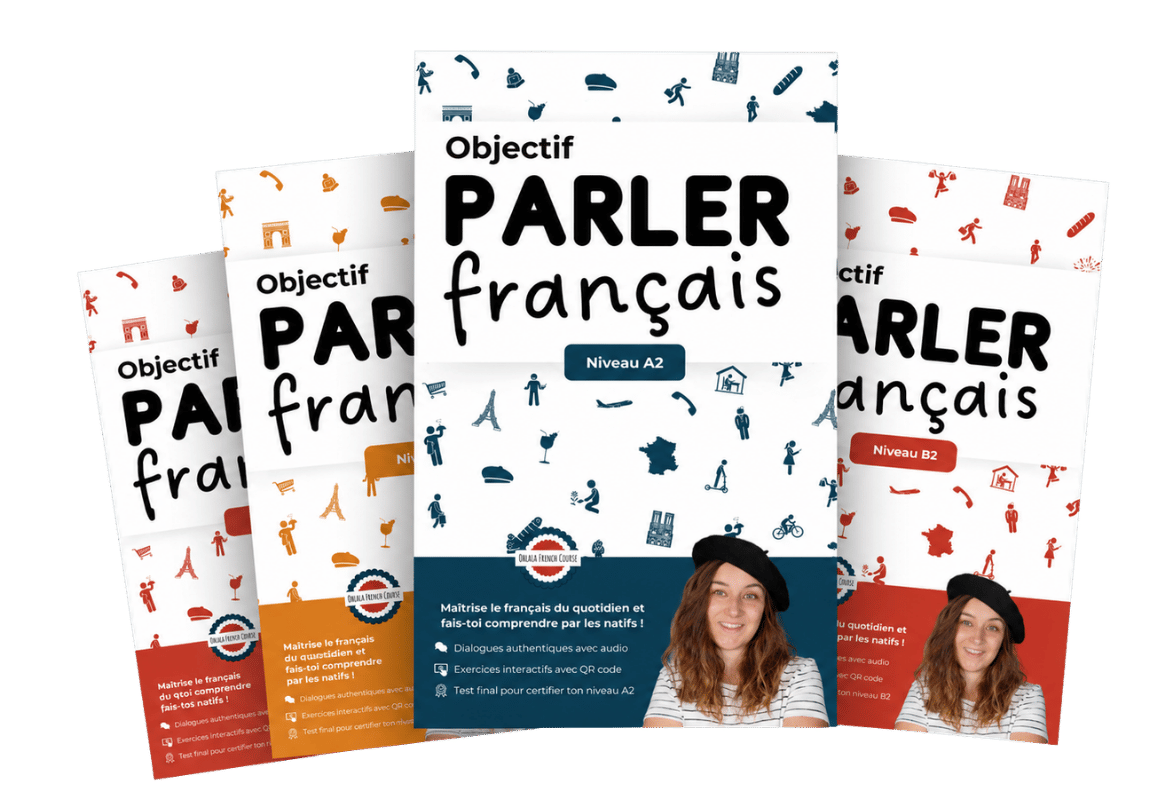
That is the approach behind my Objectif : Parler français books: complete phrases in realistic dialogues, with audio recorded by native speakers. Listen, repeat, then adapt the phrases to your own life.
6. « Depuis combien de temps tu apprends le français ? »
You will also hear: “Ça fait combien de temps que tu apprends le français ?” Both ask how long you have been learning French.
26. « J’apprends le français depuis six mois. »
I’ve been learning French for six months.
For an activity that continues now, French often uses the present tense with depuis.
27. « Ça fait deux ans que j’apprends le français. »
I’ve been learning French for two years.
Ça fait + duration + que is a very natural structure in spoken French.
28. « J’ai commencé il y a trois ans. »
I started three years ago.
Il y a means ago here: it tells you when the action started.
29. « Je l’apprends depuis longtemps, mais pas régulièrement. »
I’ve been learning it for a long time, but not consistently.
An honest answer that many language learners can use. L’ refers to French.
30. « J’ai repris le français récemment. »
I recently started learning French again.
Reprendre means to resume something after a break.
7. « Qu’est-ce que tu fais ce week-end ? »
These answers give the other person more to respond to.
31. « Je n’ai encore rien prévu. »
I haven’t planned anything yet.
Your plans are not decided yet. They may still change.
32. « Je vais voir des amis. »
I’m going to see friends.
Aller voir quelqu’un means to visit someone or spend time with them.
33. « Je pense rester tranquillement chez moi. »
I think I’ll have a quiet time at home.
A natural way to describe a plan that is not completely certain.
34. « Ça dépendra de la météo. »
It will depend on the weather.
This easily invites the other person to share their own plans.
35. « Samedi, je me repose, et dimanche, je vais faire une randonnée. »
On Saturday, I’m resting, and on Sunday, I’m going hiking.
A fuller answer with two activities. Je vais faire uses the near future.
Mini-test 2
Choose your answer before reading the suggestion.
Someone asks how long you have been learning French. You started two years ago and are still learning.
Suggested answer: « Ça fait deux ans que j’apprends le français. »
You have no weekend plans yet, but that could change.
Suggested answer: « Je n’ai encore rien prévu. »
You studied French in the past, stopped, then recently started again.
Suggested answer: « J’ai repris le français récemment. »
8. « Tu veux… ? »
This can be an invitation or an offer. Here is how to accept, hesitate or decline.
36. « Oui, avec plaisir ! »
Yes, I’d love to!
A warm way to accept an invitation or an offer.
37. « Oui, pourquoi pas ? »
Yes, why not?
You accept the idea, even if you had not thought of it before.
38. « Ça me dit bien. »
That sounds good to me.
This expression shows that the suggestion appeals to you.
39. « Pas maintenant, peut-être plus tard. »
Not now, maybe later.
You turn down the proposed timing, not necessarily the idea itself.
40. « Merci, mais je vais passer mon tour. »
Thanks, but I’ll sit this one out.
Passer son tour means choosing not to take part this time. A fairly gentle refusal.
9. « Qu’est-ce que tu en penses ? »
This asks for your opinion. Avoid answering only yes or no.
41. « Je trouve que c’est une bonne idée. »
I think it’s a good idea.
Je trouve que is a very natural way to express an opinion.
42. « À mon avis, c’est un peu risqué. »
In my opinion, it’s a little risky.
À mon avis clearly introduces your point of view.
43. « Je suis plutôt d’accord. »
I mostly agree.
Plutôt softens your agreement: you broadly agree, but perhaps not completely.
44. « Je ne suis pas tout à fait convaincu. »
I’m not entirely convinced.
A measured way to express doubt. A woman writes convaincue.
45. « Je n’y avais jamais pensé comme ça. »
I’d never thought about it that way.
This shows that the other person’s idea gives you a new perspective.
10. « Tu peux… ? »
Here is how to accept or decline a request without sounding cold.
46. « Oui, bien sûr. »
Yes, of course.
Simple, positive and natural.
47. « Pas de problème, je m’en occupe. »
No problem, I’ll take care of it.
You accept the task and take responsibility for it.
48. « Je peux essayer. »
I can try.
You agree to make an effort without promising a successful result.
49. « Je ne peux pas aujourd’hui, mais je peux le faire demain. »
I can’t today, but I can do it tomorrow.
You decline the suggested timing while offering a solution.
50. « Désolé, je ne vais pas pouvoir. »
Sorry, I won’t be able to.
A very common, softer way to say you cannot do something. A woman writes désolée.
Compare these three answers:
« Non. » — This can sound abrupt.
« Désolé, je ne vais pas pouvoir. » — You decline politely.
« Je ne peux pas aujourd’hui, mais je peux le faire demain. » — You decline and suggest an alternative.
Keep the conversation going: answer + detail + question
Remember this simple formula: answer + detail + question.
— Ça va ?
— Ça va beaucoup mieux. J’étais malade la semaine dernière. Et toi ?
— Tu habites où ?
— J’habite près de Bordeaux depuis trois ans. Tu connais la région ?
— Qu’est-ce que tu fais ce week-end ?
— Je vais voir des amis samedi. Et toi, tu as prévu quelque chose ?
You do not need to talk for five minutes. A small detail and a question often turn a short answer into a real conversation.
Your turn to practise
Your challenge: answer these three questions.
- Tu viens d’où ?
- Depuis combien de temps apprends-tu le français ?
- Qu’est-ce que tu fais ce week-end ?
Try using three answers from this article, then add a question to keep the exchange going.
For more everyday questions, answers and dialogues, explore my Objectif : Parler français books.
With the native-speaker recordings, listen to the rhythm, repeat the phrases, then create your own answers.