50 Phrases French People Use All the Time in Summer
Reading time: 14 min
Table of Contents
- Why learn summer phrases in French?
- Phrases for talking about the heat
- Phrases for talking about holidays
- Phrases for the beach and the swimming pool
- Phrases for apéritifs and summer evenings
- Phrases for travelling in France
- Phrases for small summer problems
- Natural mini-dialogues
- Common mistakes to avoid
- Key takeaways
- FAQ
- Practice your French this summer
Summer in France isn’t just about sunshine.
It’s also about café terraces.
Apéritifs.
Crowded beaches.
Delayed trains.
Sunburns.
And French people saying every five minutes:
“Il fait une chaleur pas possible.”
If you’re learning French, summer is the perfect time to expand your vocabulary.
Because you can learn useful phrases.
Short phrases.
Natural phrases.
Phrases that French people actually use in everyday life.
The real goal:
Not to speak like a French textbook.
But like someone who knows what to say at the right moment.
Even when it’s 35 degrees and your brain starts melting.
Today, I’m giving you 50 French phrases for summer.
With English translations.
With context.
And with examples so you know when to use them.
Why learn summer phrases in French?
Because summer changes conversations.
People talk more easily.
People go out more often.
People travel.
People meet others.
And above all, people repeat the same phrases over and over.
When you know these phrases, you understand French people better.
And you can join the conversation without searching for words for three minutes.
The right habit:
Don’t just learn isolated words like “sun,” “beach,” or “holiday.”
Learn complete phrases.
Because in a real conversation, you don’t need a dictionary. You need ready-to-use sentences.
Phrases for talking about the heat
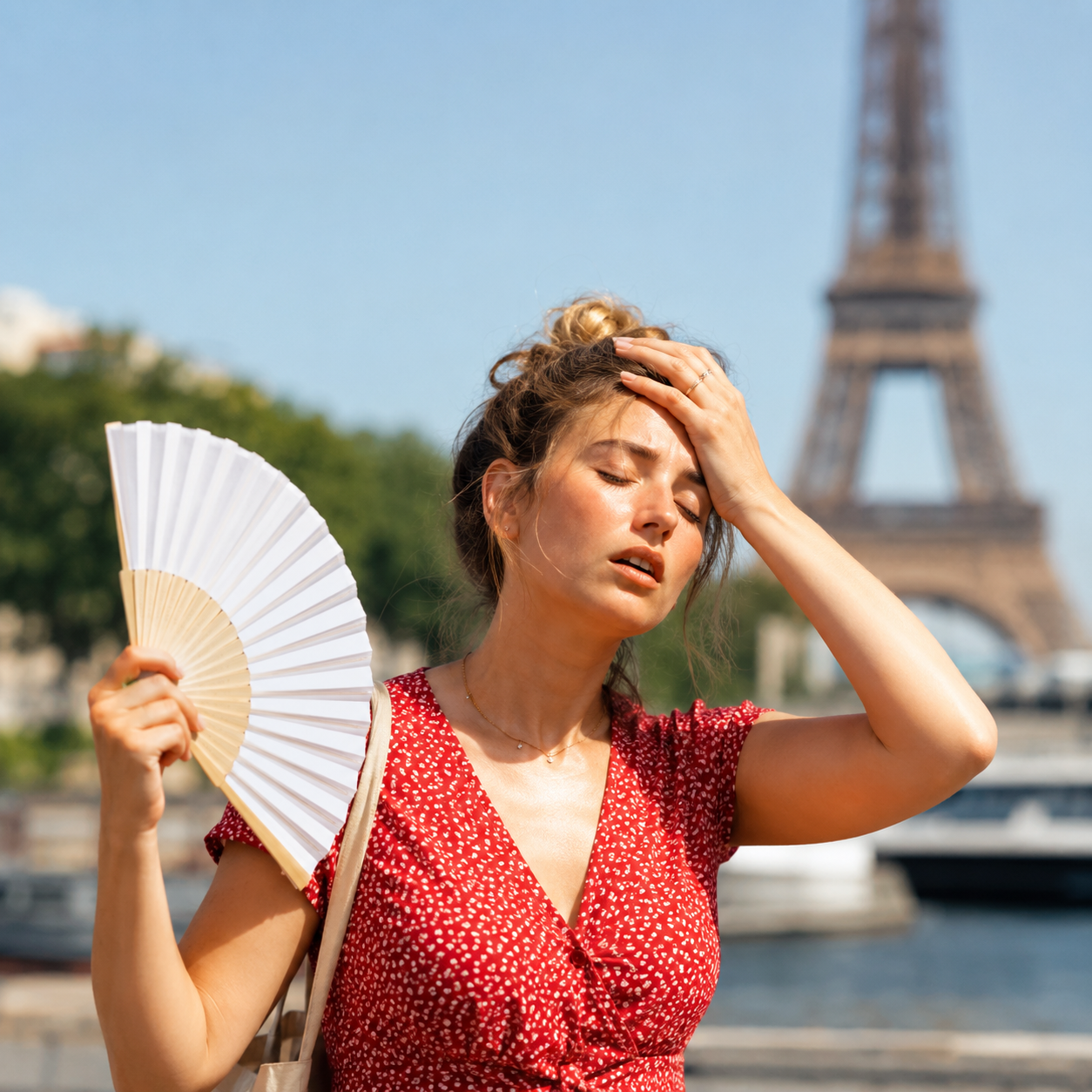
Let’s start with the number one topic of summer in France:
the heat.
French people love talking about it.
And often, they love complaining about it.
1. Il fait chaud. (It’s hot.)
Simple, correct, natural.
Example: “Il fait chaud aujourd’hui.”
2. Il fait super chaud. (It’s really hot.)
Very common in spoken French.
Example: “Il fait super chaud dans cet appartement.”
3. J’ai trop chaud. (I’m too hot.)
You’re talking about your personal feeling.
Be careful: we say j’ai chaud, not je suis chaud.
4. Je meurs de chaud. (I’m dying of heat.)
A very natural, slightly exaggerated expression.
Example: “Je meurs de chaud, on peut se mettre à l’ombre ?”
5. Il fait une chaleur pas possible. (It’s unbelievably hot.)
Very French.
You can use it when the heat becomes really unpleasant.
6. On étouffe. (It’s suffocating.)
When the air feels heavy and difficult to breathe.
Example: “On étouffe ici, ouvre la fenêtre.”
7. Il fait lourd. (It’s muggy / the air feels heavy.)
When it’s hot and humid.
Example: “Il fait lourd, il va sûrement y avoir de l’orage.”
Would you like to receive more natural phrases like these?
Subscribe to the Ohlala newsletter.
You’ll receive useful, living French, with examples you can actually use in a conversation.
Phrases for talking about holidays
In summer, French people talk a lot about holidays.
Where they’re going.
When they’re leaving.
Whether they’ve booked anything.
Whether they need a break.
In short, everyone looks forward to the holidays.
8. Tu pars en vacances cet été ? (Are you going on holiday this summer?)
A very common question in June or July.
9. Je pars en vacances la semaine prochaine. (I’m going on holiday next week.)
A simple and very useful sentence.
Example: “Je pars en vacances la semaine prochaine, j’ai trop hâte.”
10. On part dans le sud. (We’re going to the south.)
In France, “le sud” often means the south of France.
Sunshine, sea, warm weather, and cicadas.
11. J’ai besoin de vacances. (I need a holiday.)
Very natural when you’re tired.
Example: “Je suis épuisé, j’ai vraiment besoin de vacances.”
12. Ça va me faire du bien. (It’s going to do me good.)
A very French expression.
People use it when they’re looking forward to something that will help them relax or feel better.
13. Je vais couper un peu. (I’m going to disconnect for a bit.)
A very natural way to say you’re taking a break, especially from work.
Example: “Pendant mes vacances, je vais couper un peu.”
14. On a réservé un petit Airbnb. (We booked a little Airbnb.)
A very common sentence in holiday conversations.
Phrases for the beach and the swimming pool
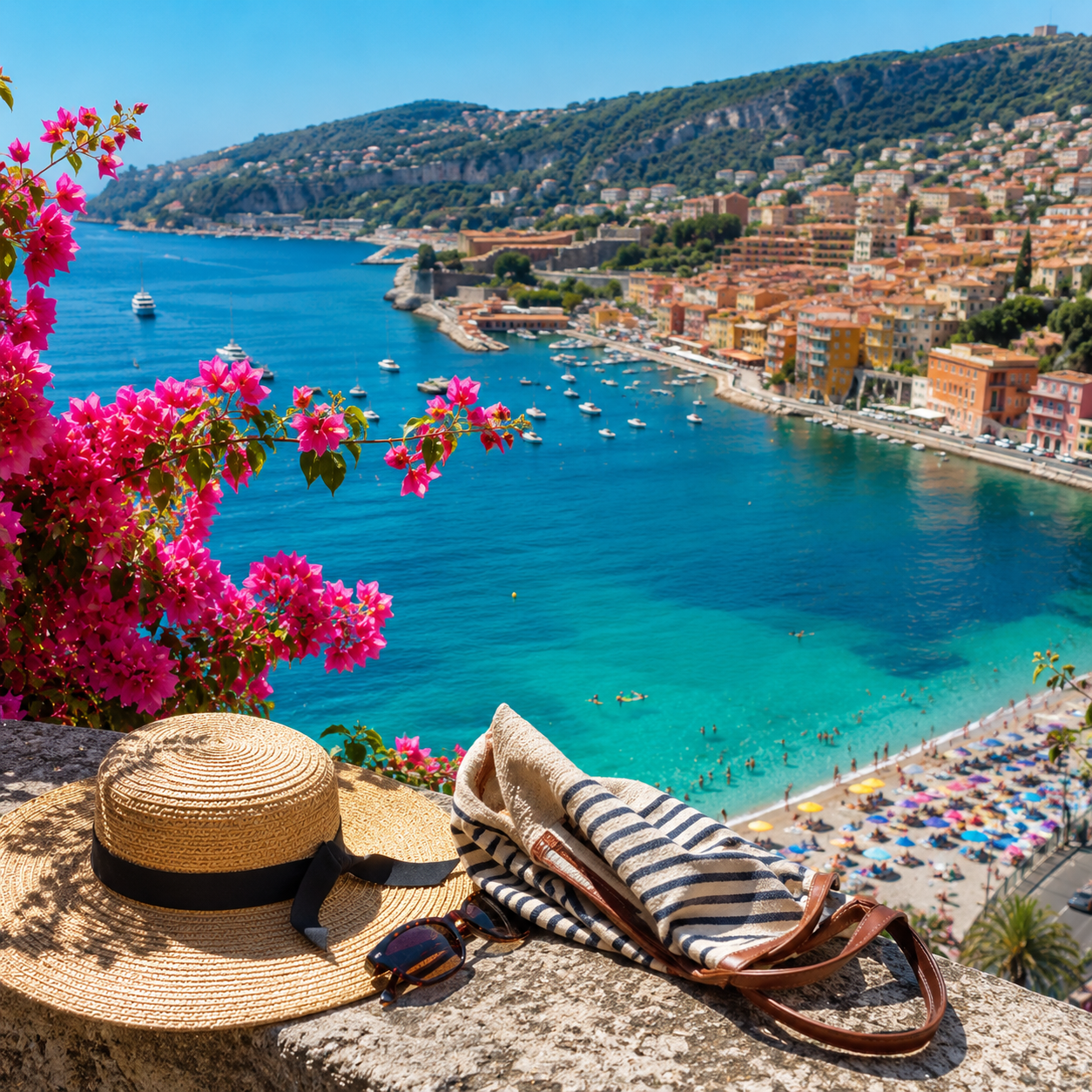
If you spend summer in France, you may go to the beach, the swimming pool, a lake, or a river.
And there, you’ll hear very simple phrases.
But very useful ones.
15. On va à la plage ? (Shall we go to the beach?)
Simple. Direct. Very summery.
16. Tu viens te baigner ? (Are you coming for a swim?)
Se baigner = to go into the water to swim or cool off.
17. Elle est bonne ? (Is the water nice?)
A very French phrase.
It refers to the water temperature.
If someone is already in the water, you can ask: “Elle est bonne ?”
18. Elle est froide ! (It’s cold!)
The classic answer when the water isn’t as pleasant as expected.
19. Je vais juste tremper les pieds. (I’m just going to dip my feet in.)
Perfect if you don’t feel like swimming.
20. Tu peux me mettre de la crème solaire ? (Can you put sunscreen on me?)
Very useful if you don’t want to end up red as a tomato.
21. J’ai pris un coup de soleil. (I got sunburned.)
A summer classic.
Example: “J’ai pris un coup de soleil sur les épaules.”
22. On se met à l’ombre ? (Shall we sit in the shade?)
Very useful when the sun is beating down too strongly.
A quick tip:
These phrases are simple.
But if you practice them before you need them, they come out much more easily.
That’s exactly what we work on in our summer group classes: speaking quickly, simply, and in real-life situations.
Phrases for apéritifs and summer evenings
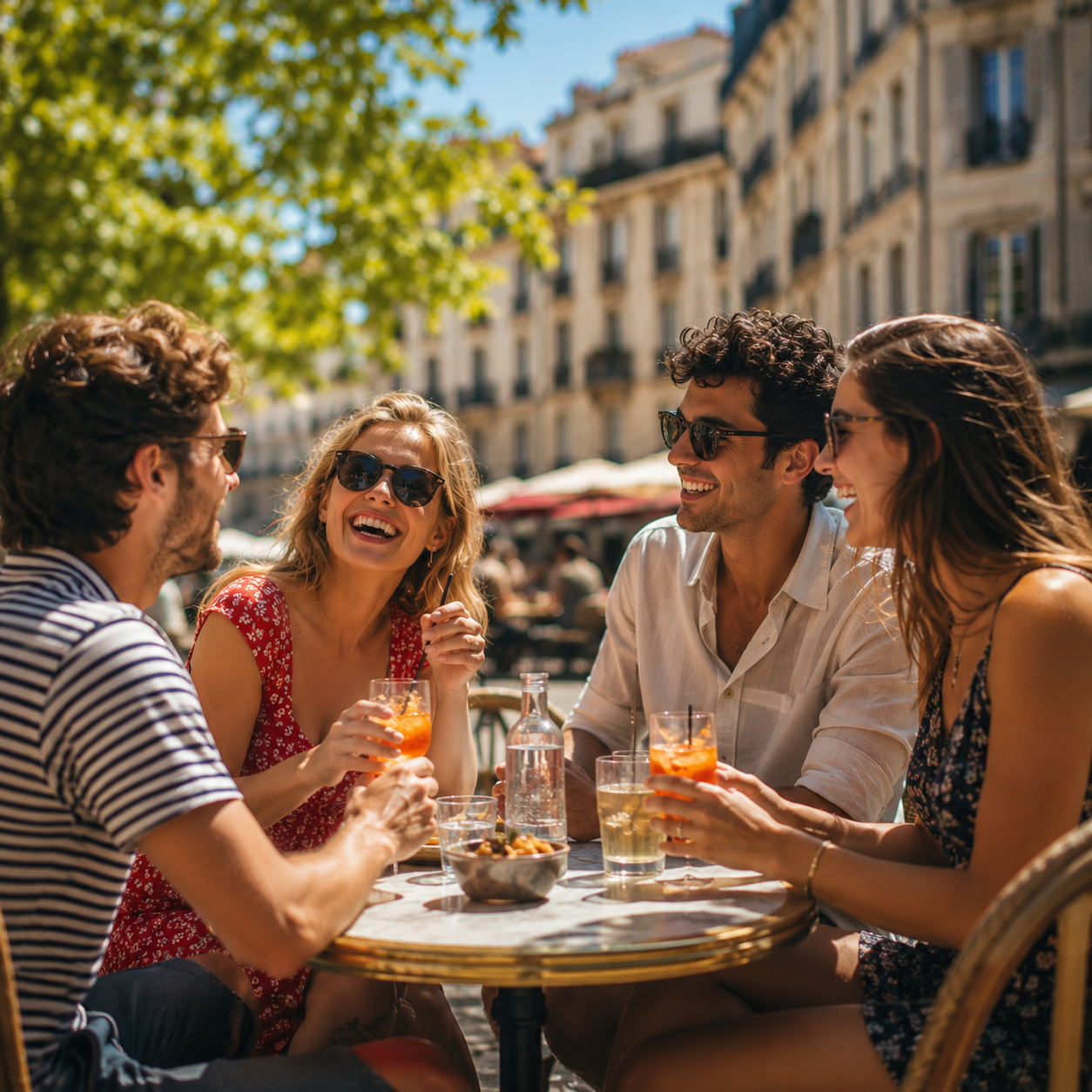
Summer in France often means apéros.
On a terrace.
In a garden.
At friends’ homes.
Or by the beach.
And for that, you need simple, natural phrases.
23. On prend l’apéro ? (Shall we have an apéritif / pre-dinner drink?)
An essential phrase in France.
An apéro is a time to have a drink and some snacks before the meal.
24. Tu veux boire quelque chose ? (Do you want something to drink?)
A simple, polite, and very useful phrase.
25. Je vais prendre un verre de rosé. (I’ll have a glass of rosé.)
Very summery.
Especially in the south of France.
26. Tu veux grignoter quelque chose ? (Do you want something to snack on?)
Grignoter = to eat small things, not a full meal.
27. On mange dehors ce soir ? (Shall we eat outside tonight?)
A very common phrase when the weather is nice.
28. Il fait bon ce soir. (The weather feels nice tonight.)
Be careful: “il fait bon” means the temperature is pleasant.
Not too hot, not too cold.
29. On reste encore un peu ? (Shall we stay a little longer?)
Perfect for a summer evening that keeps going.
Phrases for travelling in France
In summer, many people travel around France.
By train.
By car.
By plane.
And of course, there are always a few useful phrases to know.
30. On part à quelle heure ? (What time are we leaving?)
Very useful before setting off.
31. Il y a du monde sur la route. (There are a lot of people on the road / There’s traffic.)
A very French phrase during the big holiday departures.
32. On est coincés dans les bouchons. (We’re stuck in traffic.)
Les bouchons = traffic jams.
Example: “On est coincés dans les bouchons depuis une heure.”
33. On fait une pause ? (Shall we take a break?)
Very useful in the car or during a long day.
34. Tu as pris les billets ? (Did you bring the tickets?)
For the train, plane, museum, boat—anything.
35. On est bientôt arrivés ? (Are we nearly there yet?)
A classic phrase.
Children say it a lot.
But adults do too, sometimes.
Would you like to practice these phrases out loud?
At the Ohlala French School, you can work on real-life French with native teachers.
Not just rules.
Useful, natural, practical conversations.
Phrases for small summer problems
Summer is enjoyable.
But there are also little problems.
The heat.
Mosquitoes.
Sunburns.
Overcrowded places.
And here too, you need useful phrases.
36. Il y a trop de monde. (There are too many people.)
Very useful at the beach, in restaurants, or in tourist areas.
37. C’est bondé. (It’s packed.)
More natural and shorter.
Example: “La plage est bondée.”
38. Je me suis fait piquer par un moustique. (I got bitten by a mosquito.)
A very useful sentence in summer.
39. Ça gratte. (It itches.)
Simple and natural.
Example: “Cette piqûre de moustique, ça gratte.”
40. Je suis en nage. (I’m drenched in sweat.)
When you’re sweating a lot.
Example: “Après cette montée, je suis en nage.”
41. J’ai oublié mes lunettes de soleil. (I forgot my sunglasses.)
A classic little problem.
42. Je n’ai plus de batterie. (I’m out of battery.)
Very useful when you’re travelling and your phone dies at the worst possible moment.
Natural mini-dialogues
Now let’s see how these phrases come to life in a real conversation.
Dialogue 1: Leaving for a holiday
“What time are we leaving tomorrow?”
“Early. There’s going to be a lot of traffic on the road.”
“Yeah, especially if we want to avoid traffic jams.”
Dialogue 2: At the beach
“Are you coming for a swim?”
“I’m just going to dip my feet in.”
“Is it cold?”
“A little, yes.”
Dialogue 3: Summer terrace
“Shall we have an apéro?”
“With pleasure. I’ll have a glass of rosé.”
“Good idea, the weather feels nice tonight.”
Dialogue 4: Intense heat
“Shall we sit in the shade?”
“Yes, I’m dying of heat.”
“Me too. It’s suffocating.”
Dialogue 5: Eating outside
“Shall we eat outside tonight?”
“Yes, the weather is lovely.”
“Perfect, I’ll prepare something to snack on.”
Common mistakes to avoid
These phrases are simple.
But watch out for a few traps.
Mistake 1: saying “je suis chaud” to mean “I’m hot”
No.
To talk about feeling hot, say:
“J’ai chaud.”
“Je suis chaud” can mean “I’m up for it” or have a sexual connotation depending on the context.
Mistake 2: translating “I’m going on vacation” as “je vais en vacances”
The natural sentence is:
“Je pars en vacances.”
Mistake 3: saying “je prends un soleil brûlé”
No.
You should say:
“J’ai pris un coup de soleil.”
Mistake 4: using overly formal phrases in conversation
For example, you can say:
“Il fait très chaud aujourd’hui.”
But among friends, you’ll more often hear:
“Il fait super chaud.”
“Je meurs de chaud.”
“On étouffe.”
Do you understand the phrases, but freeze when it’s time to speak?
That’s normal.
Reading a sentence and using it naturally in a conversation are not the same thing.
In Ohlala’s summer group classes, you can practice these kinds of phrases in real-life situations: holidays, restaurants, the beach, apéros, and small talk.
Key takeaways
You don’t need to learn all 50 phrases today.
Start with the most useful ones.
The ones you can actually use this summer.
The 10 phrases to remember first:
1. Il fait super chaud.
2. J’ai trop chaud.
3. Tu pars en vacances cet été ?
4. J’ai besoin de vacances.
5. Tu viens te baigner ?
6. Elle est bonne ?
7. On prend l’apéro ?
8. Il fait bon ce soir.
9. On est coincés dans les bouchons.
10. C’est bondé.
With these phrases, you can already understand many summer conversations.
And most importantly, you can respond more naturally.
Without translating word for word.
Without searching for a complicated sentence.
Just using the French that French people actually use.
FAQ: French summer phrases
How do you say “it’s hot” in French?
You say “il fait chaud”. In spoken French, you can also say “il fait super chaud”.
How do you say “I’m hot” in French?
You say “j’ai chaud”. Don’t say “je suis chaud” when talking about temperature.
What does “on prend l’apéro ?” mean?
It means: “Shall we have a drink / an apéritif?” In France, an apéro is a friendly moment before a meal, usually with a drink and something to snack on.
What does “elle est bonne ?” mean at the beach?
It refers to the water. The phrase means: “Is the water nice?” or “Is the water warm enough?”
How do you say “we’re stuck in traffic” in French?
You can say “on est coincés dans les bouchons”. It’s very natural, especially during holiday travel periods.
Practice your French this summer
Now you know 50 phrases that French people use all the time in summer.
But as always, knowing a phrase isn’t enough.
You need to hear it.
Repeat it.
Use it in a real-life situation.
And use it at the right moment.
The best time to practice?
Right now.
Before your holidays.
Before you find yourself at the beach, in a restaurant, on a train, or with French friends.
That way, the phrases are already available in your mind when you need them.
If you want to keep improving, you can:
- join the Ohlala newsletter to receive natural French every week,
- discover Ohlala French School to practice with native teachers,
- join the summer group classes to speak more regularly during the holidays.
Would you like to speak French more naturally this summer?
Join Ohlala and practice real-life French.
Useful phrases.
Practical conversations.
Native teachers.
And more confidence when speaking French.
→ Practice my French this summer= 50 French phrases for summer.
Learn them.
Practice them.
And use them as soon as summer begins.