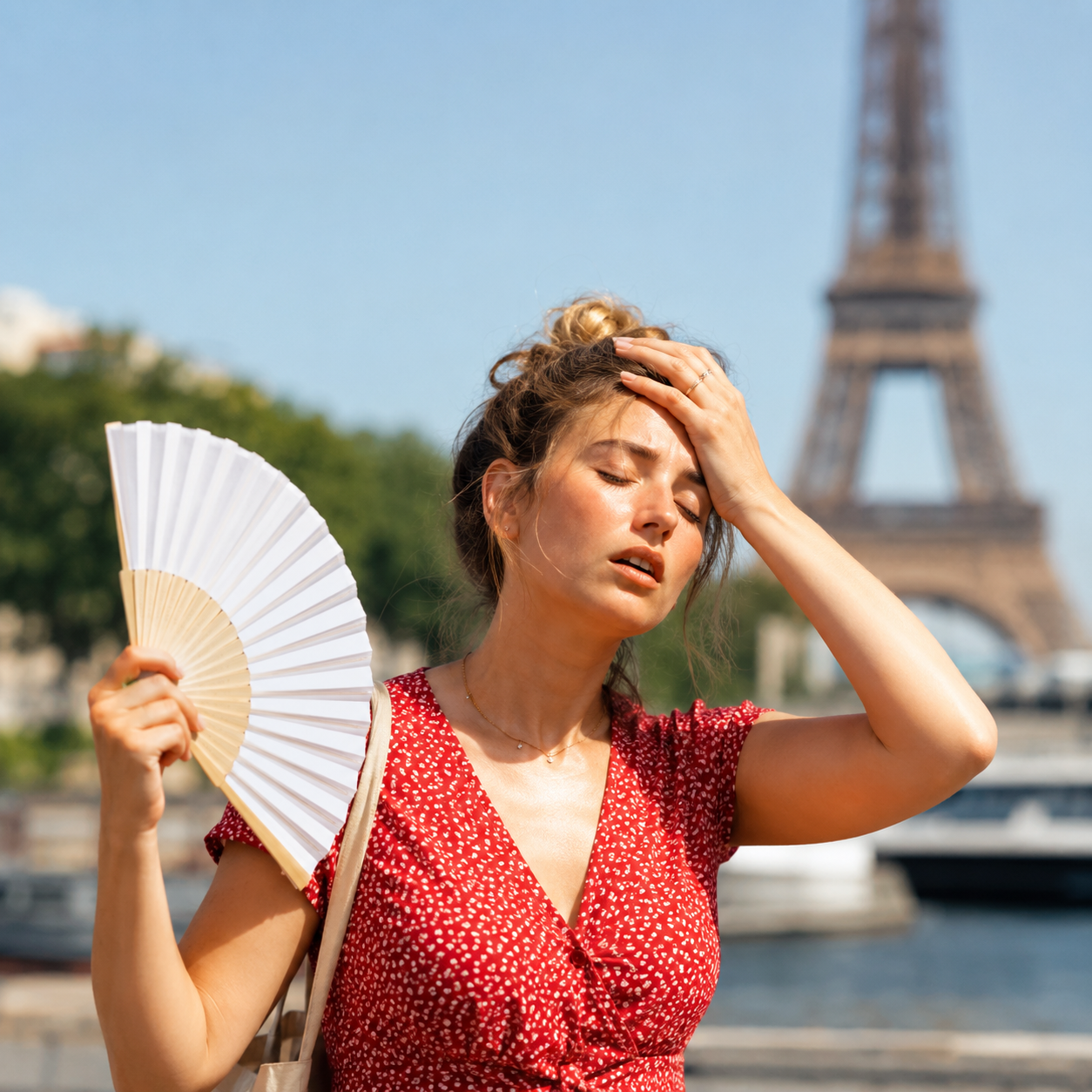
20 French Expressions to Talk About Hot Weather
Reading time: 10 min
Table of Contents
You’re in France.
It’s 35 degrees.
You’re walking down the street.
There’s no shade.
Your T-shirt is sticking to your skin.
And around you, French people are starting to complain.
Because yes.
In France, when it’s hot, people talk about it.
A lot.
The real problem:
If you only say “il fait chaud,” you’re correct.
But you miss all the little natural expressions that French people actually use.
The ones that make your French sound more alive.
Today, I’m giving you 20 French expressions to talk about hot weather.
Simple expressions.
Informal expressions.
Very useful expressions during summer, especially during a heatwave.
And as always, with concrete examples.
Why learn expressions about hot weather?
Because talking about the weather isn’t just about the weather.
In French, it’s often a way to start a conversation.
In the elevator.
At the bakery.
At work.
With neighbors.
With friends.
The habit to develop:
Don’t learn only one correct sentence.
Learn several ways to say the same thing.
That way, your French becomes more natural, more spontaneous, and more alive.
For example, you can say:
- Il fait chaud.
- Il fait super chaud.
- Il fait une chaleur pas possible.
- On étouffe.
- Je meurs de chaud.
All these sentences talk about hot weather.
But they don’t have exactly the same tone or effect.
Simple expressions to say it’s hot
Let’s start with the most useful expressions.
The ones you can use anywhere.
With anyone.
Without any risk.
1. Il fait chaud. (It’s hot.)
The basic sentence.
Simple, correct, natural.
Example:
“Il fait chaud aujourd’hui.”
2. Il fait très chaud. (It’s very hot.)
More neutral than “super chaud”.
You can use it in a normal conversation, but also in a slightly more formal context.
Example:
“Il fait très chaud cette semaine.”
3. Il fait super chaud. (It’s really hot.)
Very natural in spoken French.
A little informal, but not vulgar.
Example:
“On peut ouvrir la fenêtre ? Il fait super chaud ici.”
4. Quelle chaleur ! (It’s so hot! / What heat!)
A very French expression.
People often use it when arriving somewhere or stepping outside.
Example:
“Quelle chaleur ! Je vais prendre un verre d’eau.”
5. Il fait lourd. (The air feels heavy / It’s muggy.)
Very useful when it’s not only hot, but also humid.
The air feels difficult to breathe.
Example:
“Il fait lourd aujourd’hui, je pense qu’il va y avoir de l’orage.”
More informal expressions
Now let’s move on to expressions that sound more natural in real life.
The ones you’ll hear among friends, family, at work, or out in the street.
Not necessarily in a professional email.
But definitely in conversation.
6. J’ai trop chaud. (I’m too hot.)
You’re talking about your personal feeling.
Be careful: we say j’ai chaud, not je suis chaud.
Example:
“J’ai trop chaud, je vais enlever ma veste.”
7. Je meurs de chaud. (I’m dying of heat.)
A very common expression.
Of course, it’s exaggerated.
But French people use it all the time.
Example:
“Je meurs de chaud, on peut s’asseoir à l’ombre ?”
8. On crève de chaud. (We’re boiling / It’s insanely hot.)
Very informal.
You can use it with friends.
Avoid it in overly formal situations.
Example:
“On crève de chaud dans ce métro.”
9. Il fait une chaleur pas possible. (It’s unbelievably hot.)
Very natural.
A little dramatic, but in a good way.
Example:
“Il fait une chaleur pas possible dans cet appartement.”
10. Il fait une chaleur à crever. (It’s deadly hot / It’s boiling.)
Very informal.
People use it when the heat becomes truly unbearable.
Example:
“Il fait une chaleur à crever, je ne sors pas avant 18 heures.”
Would you like to receive more natural expressions like these?
Subscribe to the Ohlala French Course newsletter.
You’ll receive useful, natural French with examples you can actually use in conversation.
Expressions for talking about a heatwave
When it stays extremely hot for several days, we often talk about a heatwave.
A heatwave is a period of very high temperatures, both day and night.
And in France, as soon as there’s a heatwave, everyone talks about it.
11. C’est la canicule. (It’s a heatwave.)
A simple and very useful expression.
Example:
“Cette semaine, c’est la canicule dans le sud de la France.”
12. On est en alerte canicule. (We’re under a heatwave alert.)
You might hear this expression on television, on the radio, or in weather apps.
Example:
“On est en alerte canicule jusqu’à vendredi.”
13. Les températures grimpent. (Temperatures are rising.)
We use the verb grimper to say that temperatures are going up.
Example:
“Les températures grimpent partout en France.”
14. Le thermomètre explose. (Temperatures are through the roof.)
A vivid expression.
It means it’s extremely hot.
Example:
“Cette semaine, le thermomètre explose à Marseille.”
15. Il n’y a pas un souffle d’air. (There’s not a breath of air.)
Very useful when the air is completely still.
No wind.
No cool breeze.
Nothing.
Example:
“Il n’y a pas un souffle d’air, c’est insupportable.”
Expressions related to sweating
When it’s hot, we sweat.
And in French, there are several ways to say it.
Some are neutral.
Others are more informal.
16. Je transpire. (I’m sweating.)
The simple sentence.
Appropriate in every context.
Example:
“Je transpire, il fait vraiment trop chaud.”
17. Je suis en nage. (I’m drenched in sweat.)
A very French expression.
It means you’re sweating a lot.
Example:
“Après dix minutes de marche, je suis en nage.”
18. Je dégouline. (I’m dripping with sweat.)
Very visual.
A little informal.
Example:
“Je dégouline, je vais prendre une douche.”
19. J’ai le front qui perle. (My forehead is beading with sweat.)
More precise and slightly more elegant.
It refers to small beads of sweat forming on your forehead.
Example:
“Il fait tellement chaud que j’ai le front qui perle.”
20. Je colle. (I feel sticky.)
Very natural when it’s hot and humid.
You have that unpleasant sticky feeling on your skin.
Example:
“Je colle, j’ai besoin d’une douche.”
The real secret:
You don’t need to memorize 200 words.
You need natural sentences.
Sentences you can use quickly in a real conversation.
That’s exactly what we practice at Ohlala French School, my online French school.
Natural mini-dialogues
Now look at how these expressions can appear in a real conversation.
Dialogue 1: In the street
“Are we walking much longer?”
“No, we’ll be there soon.”
“Good, because I’m dying of heat.”
Dialogue 2: In an apartment
“Can you open the window?”
“Yes, of course.”
“Thanks, it’s unbelievably hot in here.”
Dialogue 3: On the subway
“Isn’t there any air conditioning?”
“No, I don’t think so.”
“We’re boiling in here.”
Dialogue 4: After a walk
“How are you doing?”
“Fine, but I’m drenched in sweat.”
“Come on, let’s go get something to drink.”
Dialogue 5: During a heatwave
“Are you going out this afternoon?”
“No, impossible. It’s a heatwave.”
“Yeah, temperatures are through the roof.”
Common mistakes to avoid
Talking about hot weather seems simple.
But there are a few traps.
Especially if you translate directly from English.
Mistake 1: Saying “je suis chaud” to mean “I’m hot”
No.
To say that you feel hot, say:
“J’ai chaud.”
“Je suis chaud” can mean “I’m up for it” or have a sexual meaning depending on the context.
Mistake 2: Saying “la météo est chaude”
That’s not natural.
Instead, say:
“Il fait chaud.”
“Il fait très chaud.”
Mistake 3: Using an overly informal expression with everyone
“On crève de chaud” is very natural.
But it’s informal.
With a teacher, a colleague, or someone you don’t know well, it’s better to say:
“Il fait vraiment très chaud.”
Mistake 4: Learning expressions without context
An expression on its own is difficult to remember.
An expression inside a mini-situation is much easier.
Do you understand the sentences, but freeze when it’s time to speak?
That’s normal.
Reading an expression and using it in a conversation are not the same thing.
At Ohlala French School, you practice with native teachers in real-life situations so that these expressions become more natural when you speak.
Key takeaways
You don’t need to use all of these expressions right away.
Start with the simplest ones.
Then gradually add more natural expressions little by little.
The 5 expressions to remember first:
1. Il fait chaud.
2. J’ai trop chaud.
3. Il fait une chaleur pas possible.
4. Je meurs de chaud.
5. Je suis en nage.
With these five expressions, you can already talk about hot weather in a more natural way.
And most importantly, you’ll better understand French people when they complain about summer.
Which happens quite often.
FAQ: French expressions for talking about hot weather
How do you say “it’s hot” in French?
You say “il fait chaud”. It’s the simplest and most natural expression.
How do you say “I’m hot” in French?
You say “j’ai chaud”. Don’t say “je suis chaud” when talking about temperature.
What does “je meurs de chaud” mean?
It means you’re really, really hot. It’s an exaggerated expression, but it’s very common in spoken French.
What does “on crève de chaud” mean?
It means it’s extremely hot. It’s informal, so it’s best used with friends or people you know well.
Which expression can I use during a heatwave?
You can say “c’est la canicule”, “on est en alerte canicule”, or “le thermomètre explose”.
Practice your French this summer
Now you know 20 French expressions for talking about hot weather.
But as always, knowing an expression isn’t enough.
You need to practice it.
Hear it.
Repeat it.
Use it in a real conversation.
The best time to practice?
This summer.
Because these expressions are useful right now.
When it’s hot.
When you travel.
When you want to speak more naturally.
If you want to keep improving, you have three options:
- join the Ohlala French Course newsletter to receive natural French every week,
- discover Ohlala French School to practice with native teachers,
- join the summer group classes to speak more regularly during the holidays.
Would you like to speak French more naturally this summer?
Join Ohlala and practice real-life French.
Useful expressions.
Practical conversations.
Native teachers.
And more confidence when speaking French.
→ Practice my French this summer= 20 French expressions for talking about hot weather.
Learn them.
Practice them.
And use them whenever it’s hot.