❌ Error #1: You're stuck in passive learning!
You spend hours listening to podcasts, watching series, or doing exercises on apps. This is what's called passive learning: you receive information, but you don't actively use it. And the problem is, language is meant to be lived, spoken, and practiced!
You might know the theory by heart – past tense conjugations, subjunctive rules – but if you never practice using them in conversation, you'll feel stuck when it's time to speak. It's like reading books about swimming... without ever jumping into the water.
Les conseils aident. Une vraie méthode donne des résultats.
Construis une habitude orale avec de la structure, de la flexibilité et de la vraie pratique chaque semaine.
Commencer à pratiquerYou need to switch to active learning, which means getting into the habit of using French regularly, speaking, asking questions, experimenting with the vocabulary and structures you're learning. In short, stop just listening and reading, and start taking action: speak up, make mistakes, correct yourself, and try again. That’s how you’ll improve!
How to practice speaking French when you're not confident and afraid to talk with natives?
You dream of speaking French fluently, but as soon as you have to open your mouth... panic sets in? Don't worry, you're not alone. Many people are afraid to talk with natives for fear of making mistakes or being judged. But let me share a solution that can truly change everything for you.
With Ohlala French Coffee, my French conversation group, you can practice your French in a supportive and pressure-free environment. The concept is simple: small conversation groups guided by certified native teachers. You get time to speak, ask questions, and most importantly, you receive corrections at the end of each session to improve quickly.
And I have great news for you: you can try it for free for 7 days, no commitment. Yes, you heard that right! It’s the perfect opportunity to get started, test the method, and see if it suits you. If it’s not for you, no worries, you can stop at any time.
❌ Error #2: You speak too fast!
Let me share a little personal story. When I moved to an English-speaking country for the first time, I still remember my first conversations with natives... and honestly, it was a total disaster. I was so stressed that I spoke way too fast, as if I wanted to get rid of every sentence as quickly as possible. The result? No one understood what I was saying, and the more I saw their confused looks, the more I panicked.
One day, a very kind person said to me: “Take your time, it’s okay.” And that’s when I understood... I needed to relax, slow down, and above all, take the time to pronounce each word clearly. It changed everything! People finally understood me when I spoke English.
Why is speaking slowly essential in French?
In French, as in all languages, clarity trumps speed. If you speak too fast:
-
Your pronunciation becomes unclear, and natives will struggle to understand you.
- You might stumble or forget words, which increases your stress.
- And most importantly, you don’t give yourself time to think about what you want to say.
Many people think they need to speak fast in French because natives speak quickly, but that’s a mistake!
In reality, the French don’t speak that fast. What gives that impression is that they often shorten words and use contractions in their speech. For example, instead of saying "Tu as vu ?", they might say "T’as vu ?" or even "T’as vu ça ?".
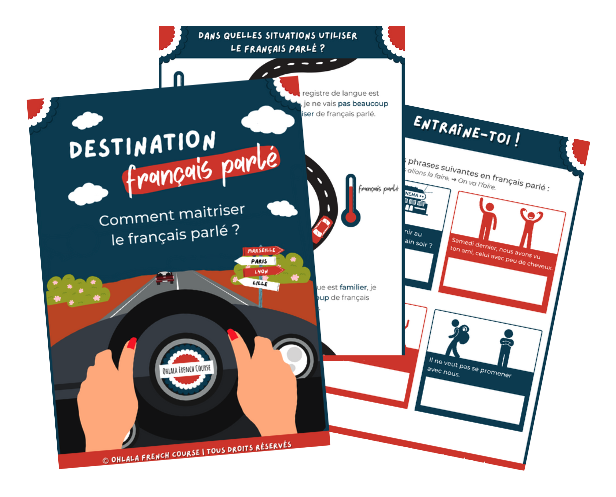
It’s not about speed, but rather about the elision and flow specific to spoken French. If you really want to understand and imitate natives without rushing, I explain all this in detail in my free eBook "Maîtriser le français parlé". Download it to discover these little secrets that will make all the difference in your conversations!
My tips for slowing down and communicating better
1️⃣ Take a deep breath before speaking 🧘
Stress makes you speed up. Before starting a sentence, take a deep breath and remind yourself that you have the right to take your time.
2️⃣ Break your sentences into chunks ✂️
Instead of trying to say everything at once, speak in blocks.
For example, instead of saying: "Demain je vais au marché acheter des fruits et ensuite je vais chez le boulanger."
Try: "Demain, je vais au marché. Je vais acheter des fruits. Ensuite, je vais chez le boulanger."
3️⃣ Enunciate each word clearly 🗣️
Even if it feels exaggerated, make it a habit to articulate. French has specific sounds, and pronouncing words clearly helps your listener understand you more easily.
4️⃣ Practice with short sentences 📝
If you tend to speed up, practice with simple, concise sentences. This will help you focus on pronunciation rather than complex structures.
5️⃣ Observe native speakers 👀
Watch how French people speak in videos or series. They don’t always speak quickly! Sometimes they slow down to emphasize an idea or articulate a difficult word. Take inspiration from their rhythm.
🎁 Bonus Tip: The Dramatic Pause
When you feel like you're losing track or getting stressed, take a brief pause. A 2-second silence might feel long to you, but it gives the impression that you're thinking about what to say. It also shows that you’re calm and confident.
Rushing is the fastest way to get lost. But by taking your time, articulating, and speaking at a relaxed pace, you’ll not only be better understood but also feel much more confident in your French conversations.
❌ Error #3: You’re afraid of making mistakes!
You hesitate to speak French because you're afraid of saying something wrong, making a grammar mistake, or using an expression at the wrong time? This fear is something I’ve seen in almost every learner. But let me tell you something: this fear is your worst enemy. It blocks you, prevents you from progressing, and, worse yet, makes you miss out on incredible opportunities to improve your French.
💡 Why is this fear unnecessary?
1️⃣ Mistakes are part of learning:
No one becomes bilingual without making mistakes. Even natives make mistakes (yes, really!), and it doesn’t stop them from communicating. Every mistake is an opportunity to learn and improve.
2️⃣ The French appreciate your effort:
Most natives admire that you’re trying to speak their language. They don’t focus on your mistakes; they focus on the effort you’re making to communicate.
3️⃣ You miss out on practice:
By avoiding speaking out of fear of mistakes, you drastically reduce your exposure to the language. And it’s through speaking that you gain confidence and fluency.
🚀 How to overcome the fear of making mistakes?
1️⃣ Change your mindset:
Instead of seeing a mistake as a failure, view it as a necessary step to progress. The more mistakes you make, the more you learn.
2️⃣ Practice in a supportive environment:
Join conversation groups where everyone is there to learn, like Ohlala French Coffee. With small groups and native teachers, you can speak without pressure and receive kind corrections.
3️⃣ Take linguistic risks:
Dare to use a word or expression, even if you’re not sure it’s correct. If it’s wrong, someone will correct you, and you’ll better remember the right version.
4️⃣ Note your mistakes to improve:
Every time you make a mistake and get corrected, write down the error and the correction. Review these notes regularly to avoid repeating the same mistakes.
5️⃣ Remember that everyone goes through this:
Even the most talented people made mistakes at the beginning. No one will judge you for it, and those learning a language understand this very well.
🎁 Bonus Tip: Turn your mistakes into a game
To make your mistakes less stressful, see them as a challenge: every corrected mistake earns you an experience point! Turn your learning into an adventure where every correction brings you closer to your goal.