The French you learn ≠ The French people actually speak
You learned to say “Bonjour, comment allez-vous ?” ("Hello, how are you?")
But a French person would more likely say: “Salut, ça va ?” ("Hey, how’s it going?")
Les conseils aident. Une vraie méthode donne des résultats.
Construis une habitude orale avec de la structure, de la flexibilité et de la vraie pratique chaque semaine.
Commencer à pratiquerYou proudly say “Je ne sais pas”... ("I don’t know")
But in real life, you’ll hear “J’sais pas” or even just “Ch’sais pas”. ("Dunno")
And this is where the real issue starts:
👉 You speak French like in a book.
But French people speak in a natural, authentic way. Very different from what’s in textbooks.
So what happens?
You make perfect sentences with great grammar, but...
They don’t “match” how native speakers actually talk.
And our brain gets confused. We understand you’re speaking French, but we have to make an effort to follow because it doesn’t sound “natural”.
The solution? Learn real French... the kind people actually speak!
Good news:
This spoken, spontaneous, living French — you can learn that too.
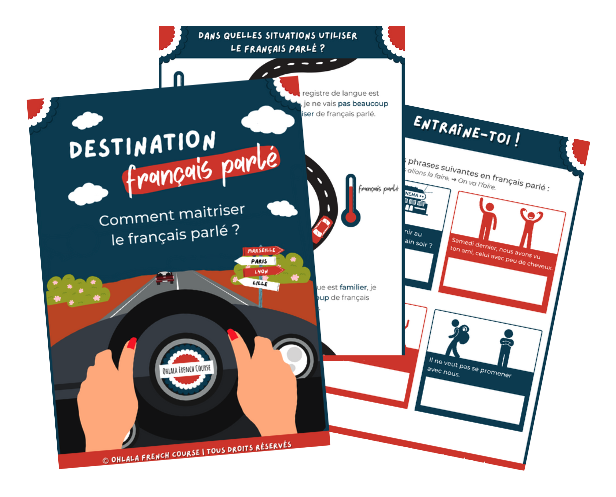
I created a free ebook for you:
“Maîtriser le français parlé” – a complete guide to discover:
- the expressions people actually use when they speak
- cut words, contractions, shortcuts
- common mistakes to avoid if you want to sound natural
- simple tips to practice every day
Once you know the real rules of spoken French, conversations become easier, smoother... and more fun!
So... do you want to speak like real French people?
Why do you freeze up when speaking?
Even if you know tons of French words, even if you understand well what you read or hear... when it’s time to speak, it often turns into a disaster.
You stammer, search for words, lose confidence. And it’s not because you’re “bad at languages” — not at all.
It’s simply because your mouth isn’t used to speaking French.
Speaking a language means training your pronunciation muscles. And that doesn’t happen in a notebook or by passively listening to podcasts.
You have to practice. Speak. Make mistakes. Try again. Laugh. Fix things.
But if you’re not used to it, of course:
- words get stuck in your head;
- your pronunciation is hesitant;
- you can’t build smooth, flowing sentences.
👉 That’s exactly why I created small group conversation classes with Ohlala French Course.
🗣️ Real, regular practice — even if you’re not confident yet
In these classes:
- You’re with 3 to 6 students max, so it’s super friendly.
- You speak every week, even if you're just starting out with speaking.
- You react to authentic content (videos, articles…)
- You're guided by native, supportive teachers.
- And after each session, you get personal notes and corrections to help you improve.
🎁 Bonus: you also get my course “30 jours pour comprendre les Français” ("30 days to understand the French") — slang, verlan, spoken French… everything they don’t teach you in school.
Basically, it’s the most effective way to unlock your spoken French and feel comfortable in real life, not just on paper.
⚠️ Heads up — spots are limited.
Cognitive overload: the French brain is overwhelmed
Picture this.
You’re in Paris. You want to speak French. You’re motivated, you craft a beautiful sentence, polite, well-structured — a little grammatical gem.
And then… the French person answers:
“Ah ok, so… where are you from?”
Why do they do that? Are they snobs? Are they trying to put you down?
No. Well… in 99% of cases, no.
The real issue is that their brain is overwhelmed.
When you speak, they have to:
- Decode your accent (which they’re not used to),
- Understand your words (which might not be clearly pronounced),
- Follow a very formal structure (that’s not used in everyday speech),
- Sort through it if you mix in some English.
➡️ Result: they get tired.
And since the brain wants to save energy, it does what all brains do under pressure: it takes the easiest route.
So they switch to English. Not to be mean.
Just to survive the conversation.
The solution? Shadowing.
If you want to be understood naturally without overloading the French brain, you need to train to speak like them.
Not like in textbooks.
But like in real life.
🎧 Shadowing is the most effective technique:
- You listen to a natural native sentence
- You repeat it right away, copying the rhythm, pronunciation, intonation
- You train your mouth to speak like a French person
The result?
You sound more natural, you’re understood better, and... people stop switching to English.