Each week, I offer you a new video on a specific topic to help you better understand authentic French. If you want to practice speaking this topic and finally gain confidence in French, join my French conversation group Ohlala French Coffee.
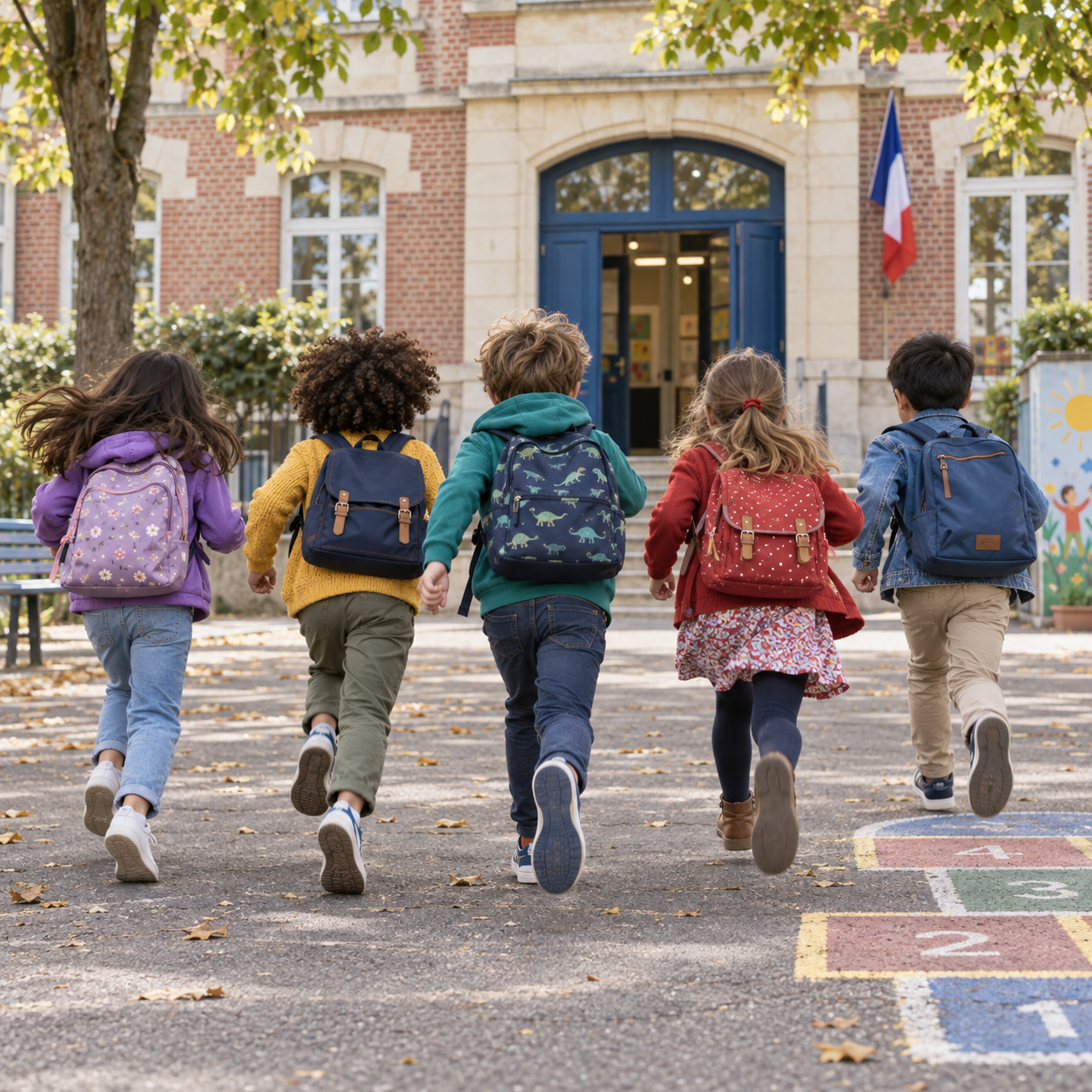
This week, it's back to school time in France! Thursday, September 2nd 2021, French schoolchildren and students are going back to school. We will take advantage of this week at Ohlala French Coffee to talk about school and education. And I'm going to talk today, in this video, about school in France. I'm going to explain you the French education system, but also how it is school in France by giving you more interesting cultural details. Here we go!
School is compulsory from the age of 3 until the age of 16. Before that, parents can put their children in a crèche or with a nanny.
Se sentir à l’aise avec des natifs demande plus que comprendre la culture.
Nos apprenants pratiquent le vrai français avec des professeurs natifs et gagnent en confiance pas à pas.
Essayer gratuitementIn France, there are public and private schools. 83% of the French population is enrolled in a public school. So we will focus on public education. Public schools in France are free and secular.
Secularism is a great French principle. To summarize secularism simply, it is a profound concept. Secularism is based on several major principles:
- the separation of the State and religious organizations,
- the equality of citizens regardless of their religious beliefs or convictions
- freedom of conscience, everyone is free to believe or not to believe,
- the prohibition of the wearing of ostentatious religious symbols in school. The school must be a neutral place without any influence or pressure preventing the child from making his own choices.
Primary Education:
Preschool :
From the age of 3, French children begin their schooling in kindergarten. The kindergarten is divided into three classes: the petite section, the moyenne section and the grande section. Children who are 3 years old start with the petite section, then the moyenne section for 4 year olds and the grande section for 5 year olds.
For some children, kindergarten is the first social setting. The goal is to teach children to live together and learn together. Kindergarten will also help children develop their communicative and artistic language through drawings, rhymes, games and dances.
In kindergarten, children have a maximum of 24 hours of class per week. Schedules may vary from one community to another, but a day may not exceed 5.5 hours of class time and the children have a 1.5 hour lunch break. In general, in kindergarten, the children have a nap during the lunch break.
Elementary School:
After kindergarten, children enter elementary school. And you may have heard the term elementary school before. Elementary school is actually the combination of kindergarten and elementary school. The elementary school is divided into five classes. At 6 years old, we go to CP (cours préparatoire), at 7 years old, we go to CE1 (cours élémentaire 1). At 8 years old, we go to CE2 (elementary class 2). At 9 years old, we go to CM1 (cours moyen 1) and at 10 years old, we go to CM2 (cours moyen 2).
In CP, CE1 and CE2, the children's goal is to acquire fundamental learning such as :
- Mastery of the French language (oral and written skills, reading, writing, etc.)
- Rules of life in society
- Mathematics
- Science
- A foreign or regional language
- Art
- And sports
It's changed a little bit from when I was in school, I don't remember starting to learn a foreign language at such a young age at all. We used to start learning a foreign language around 12 years old, in middle school. Now, children learn a foreign language earlier.
In CM1 and CM2, we will consolidate the knowledge acquired in CP, CE1 and CE2. We will also deepen our knowledge of history, geography and literature.
In primary school (kindergarten and elementary school), there is an evaluation system in place that may differ from school to school. In any case, the grade system is no longer used in primary school. Teachers will use smilies or colors more.

Secondary Education:
After primary education, French schoolchildren move on to secondary education.
Middle School:
The first stage of secondary education is middle school. Middle school is divided into four grades: sixth, fifth, fourth and third. The sixth grade begins at age 11 and ends with the third grade at age 15.
In middle school, the subjects seen in primary school are reviewed in more detail and in depth. There are also new subjects, such as physics and chemistry, technology, art history and media and information literacy.