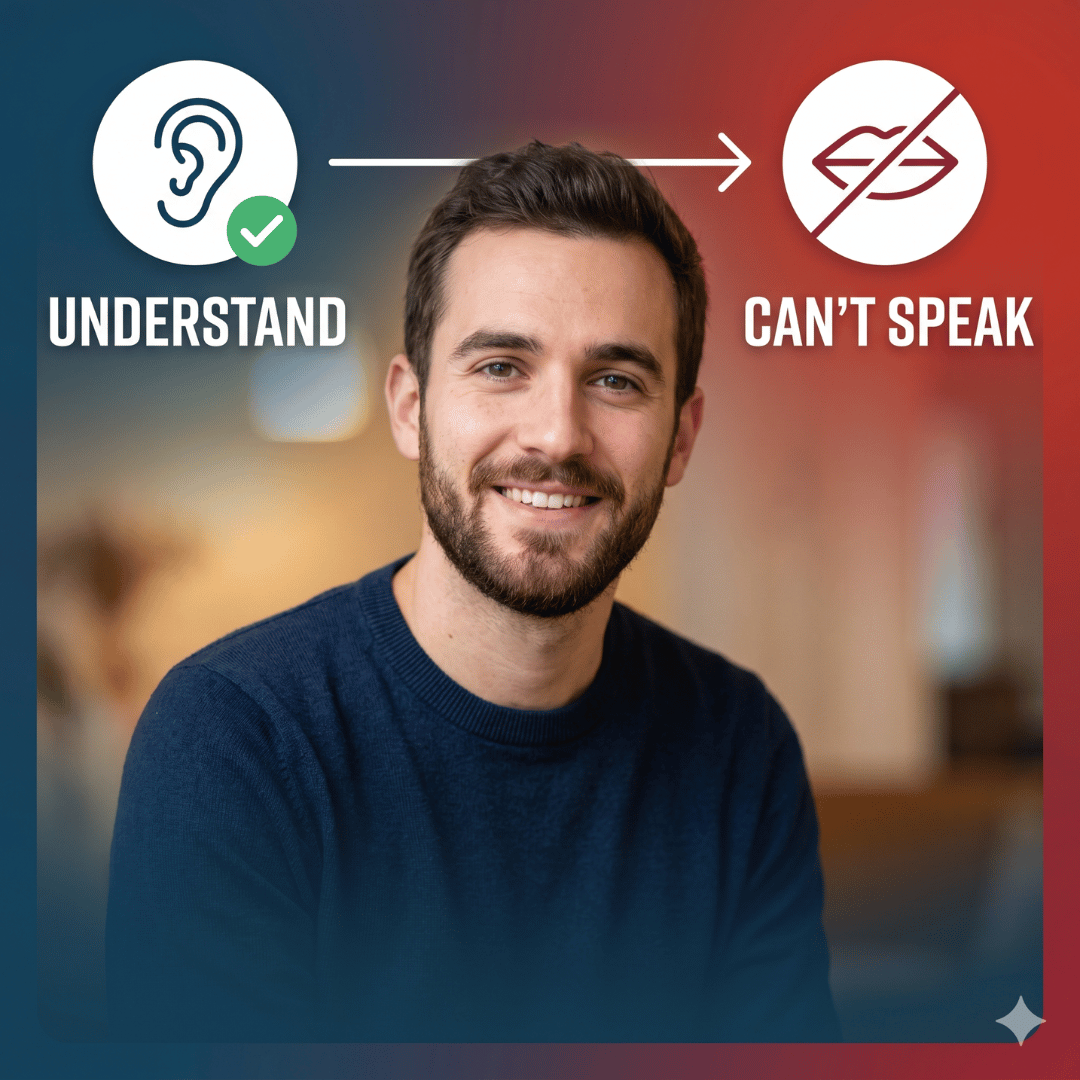
You watch videos in French. You listen to podcasts. You even understand when someone speaks to you directly in French.
But when it’s your turn to speak? Radio silence.
Your brain goes into ❌ 404 error mode. You freeze. You mentally translate every word. You search for the perfect sentence.
Tips are useful. A real method gets results.
Build a speaking habit with structure, flexibility, and real practice every week.
Start practicingAnd the more you overthink it, the harder it gets.
Good news: If this happens to you, you’re not bad. It’s just a normal stage. And most importantly, it can change.
Understanding vs Speaking: why it’s not the same thing
This is the first thing to understand: understanding and speaking are NOT the same process.
|
👂 Understanding Passive Your brain receives information. |
🗣️ Speaking Active Your brain has to produce information. |
When you understand, your brain simply picks up structures, sounds, and words. It’s easy. It’s passive.
When you speak, your brain has to do many things at the same time:
- Choose the right words
- Build a grammatically correct sentence
- Conjugate verbs correctly
- Pronounce properly
- Think about what you want to say
- Manage stress and anxiety
All of that. At the same time. It’s much harder.
So if you understand well but struggle to speak, it’s not a level problem. It’s simply that you haven’t practiced speaking enough.
Why do you freeze when you speak French?
The myth: "I’ll speak when I’m ready"
Many people tell themselves:
- "I’ll speak when I’m really ready"
- "I need to learn more vocabulary first"
-
"I need to master the subjunctive before"
But here’s the truth:
You become ready BY SPEAKING, not before.
You become fluent by being imperfect, not by being perfect.
If you wait to be perfect, you’ll wait a long time. A very long time.
The trap of mental translation
Another very common problem: you translate in your head.
Here’s the blocking cycle:
- You think in English
- You look for the French version
- You fix the grammar
- You check if it’s correct
- In the end, you say nothing
Result: You’re too slow.
In a real conversation, people won’t wait 15 years while you build your sentence in your head.
And that creates a lot of stress.
The goal is not to translate faster. The goal is to stop translating completely.
To do that, you need to train your brain to speak directly in French. And you won’t get there just by reading grammar rules.
You need to speak. Often.
The real problem: not enough real practice
Let’s be honest.
Many people spend 90% of their time:
- Watching YouTube videos in French
- Listening to podcasts
- Doing grammar exercises
But how much real time do you spend actually speaking? 5 minutes a week? 10 minutes?
Imagine learning to swim by watching YouTube videos.
You would understand the theory. You would know what to do. But in the water, you would panic.
French conversation is like water. You need to get used to it. You need to practice it.
Stress: the silent blocker
When you speak French, sometimes your brain panics:
😰 Thoughts that block you:
- "What if I make a mistake?"
- "My accent sounds bad, right?"
- "Will they understand me?"
Here’s the problem: stress prevents you from accessing words you ALREADY know.
So afterward, you think: "But I knew that word!"
The problem isn’t motivation. It’s the system.
Our learners follow a clear path that helps them stay consistent and actually improve.
Try it freeYes. But stress blocked everything.
The good news: The more you speak, the less your brain sees speaking as a threat. The more you repeat, the more confident you become.
How to start speaking French: 5 practical steps
Okay. Now you understand the problem. What do you do?
1. Speak often, even if it’s not perfect
Consistency is much more important than perfection.
It’s better to speak 10 minutes every day than 2 hours once a month.
2. Use simple but natural sentences
You don’t need complex sentences to speak French well.
Simple, well-pronounced sentences are already very good.
3. Do shadowing
Shadowing = you repeat after someone speaking French.
Watch a video, pause it, and repeat exactly what was said.
It sounds simple, but it’s very effective to make sentences come automatically.
4. Train your quick reactions
Try answering simple questions in French without overthinking.
You’ll be slow at first. That’s normal. Your brain adapts.
5. Accept discomfort
The block disappears with regular practice.
But before that, you’ll feel awkward. You’ll hesitate. You’ll make mistakes.
That’s normal. That’s the process.
Knowing vs Using: the real difference between A2, B1 and B2
There’s a big difference between two things:
|
I know this word You’ve seen it, you recognize it when you hear it. |
I can use it immediately You can say it naturally in a sentence. |
At B2 level, it’s not about how much vocabulary you know. It’s about your ability to:
- Explain an idea clearly
- Tell a story
- React naturally in a conversation
- Give your opinion and defend it
- All of that without freezing.
And to develop this ability, you need practice. There’s no secret. No magic shortcut.
Just practice. Regular. Structured. With someone.
The solution: practice in real conversations
If you understand French well but struggle to speak, it’s not a level problem.
It’s simply that you’ve focused more on understanding than on speaking.
Now, you need to develop your speaking ability.
It takes time. It requires consistency. And most importantly, you need the right place to practice.
That’s why I created Ohlala French School.
Ohlala is like a gym for your French. You show up, you train, and you get better.
Here’s what you’ll find inside Ohlala:
|
🗣️ Daily sessions One conversation EVERY DAY. Yes, really every day. |
👥 Small groups You speak with 2–4 other students and a native teacher. |
|
💬 Real-life situations No boring exercises. Real conversations about topics that matter to you. |
📚 All levels From A2 to C1. You join the group that fits your level. |
|
📈 Structured progress You also get full lessons (speaking, vocabulary, grammar in context). |
⚡ You don’t stay passive You practice. You become more reactive. You learn to respond faster. |
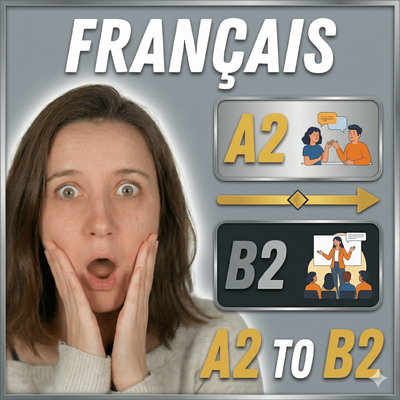
The result? Many of our students go from A2 to B2 in about 1 year. And most importantly, they speak without freezing.
Ready to speak French?
Try Ohlala for 7 days. Completely free.
You’ll get access to a conversation session with a real teacher and other learners like you.
Ready to follow a method that finally helps you speak?
Join Ohlala French School and build real confidence with structured lessons and daily speaking practice.
Start your 7-day free trial