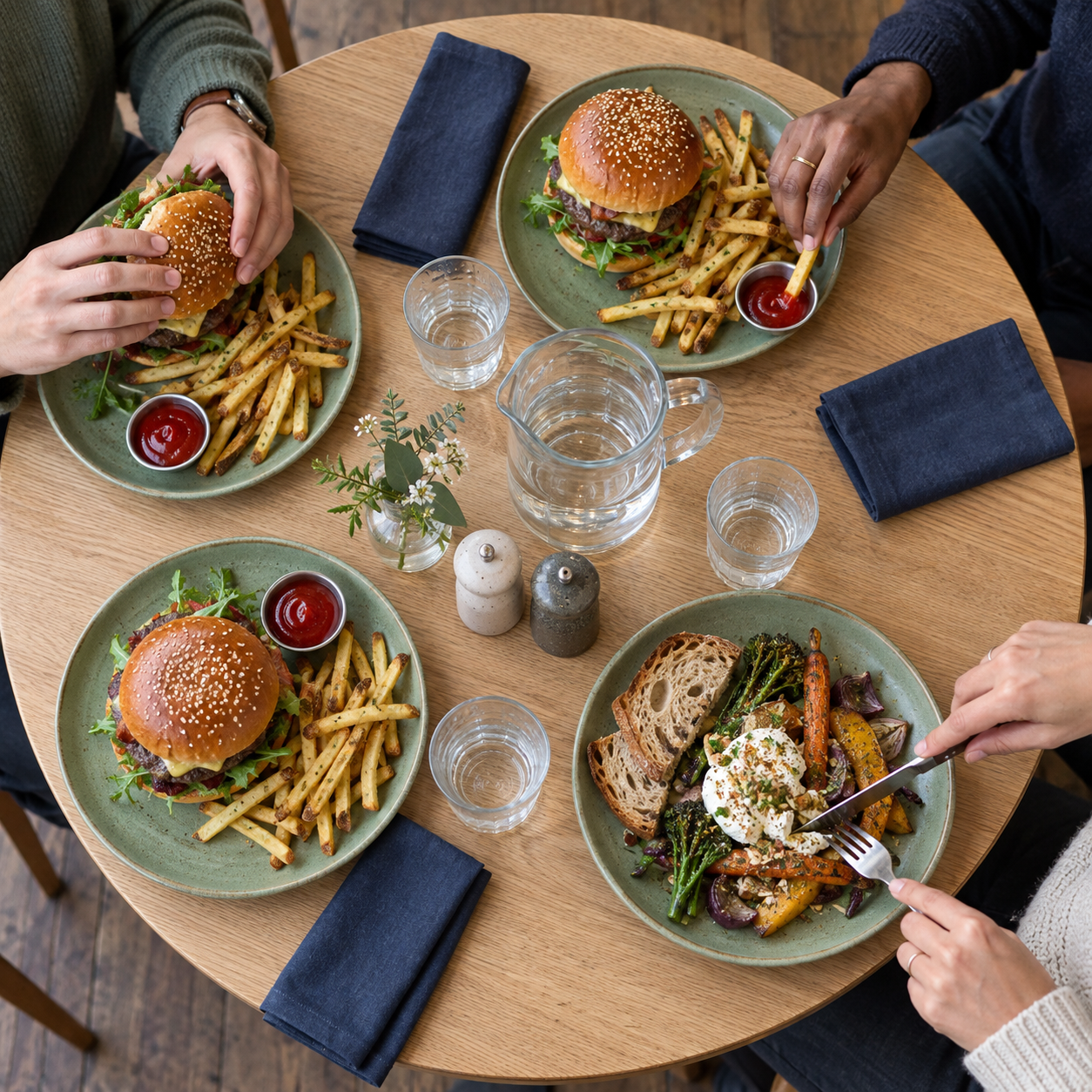
The first thing you need to know before arriving in France is order food in a restaurant in French. This is important if you want to eat and also to taste the French food which is one of the best in the world.
Today we'll look at four ways to order food in a restaurant in French. More precisely, we will see how to order food in a restaurant in French in three different language registers : the informal register, the common register, and the formal register.
The registers of language in French :
Tu veux aller plus loin avec ton français ?
Progresse avec des professeurs natifs, des leçons structurées et de la vraie pratique orale.
En savoir plusA little reminder about language registers:
The language registers make it possible to categorize vocabulary, expressions and turns of phrase according to the situation in which you are or with whom you are communicating.
Mostly, we use common language, it's a neutral register that can be used with everyone without any problem.
If I am with friends, family, people I know very well, I can use with them a informal language.
If I am in more formal situations, such as a meeting with my banker, or in a business interview, I will use a more formal language register.
And more rarely, if I'm in a situation with people of a very very very high social class, in an ultra sophisticated setting it's better to use sustained language. Or if I'm writing a book, I can use a elevated language.
Elevated and formal language are sometimes quite close, for the dialogues that we are going to see today I am going to assemble sustained and formal language.
We will now see how to address the waiter to order our meal in these different registers of language.
In the corner bistro (informal language):
We will see how order food from the local bistro in French.
When we use in French "le coin", it means a place not far from our home, in our village or neighborhood. It is a friendly place where everyone knows each other and where the exchanges are rather familiar.
Let's see an example of how to order food in the local bistro:

In most restaurants (common language) :
Let's see now how order food in most restaurants in French. We will use a common language register here.

In a starred gastronomic restaurant (formal language):
We will now see how to order and address the waiter in a gastronomic restaurant in French. The language register here will be much more formal.

Dialogue Analysis:
You have certainly noticed some differences in these dialogues.
Let's take a closer look and see the main differences between the three French language registers.
Greetings:
In informal language, we are more likely to say “Salut”. It's only for people we know, we do not use “Salut” with strangers.
In common and formal language, we say “Bonjour”. We can use “Bonjour” with everyone without any problem.
Here in the gastronomic restaurant we add “Bienvenue”, because it is a more sophisticated place where the reception must be perfect.
The "tutoiement" / the "vouvoiement" :
The tutoiement is the fact of saying "tu" and the vouvoiement, is the fact of saying "vous". This is a very important mark to distinguish if we are in formal or informal situations.
We will be on first-name terms with someone we know well: a friend, a good acquaintance, his family.
In the first dialogue, we know the person who manages the bistro, so we can say "tu". It is a less formal and friendly place, so saying "you" is natural.
In the two other dialogues, we are in a situation where we don't know the waiter. We are in a more formal situation, so we will use "vous".
Pronunciation:
When speaking, there is a strong tendency not to pronounce all the syllables in words, but even more so if you are in an informal situation.
In particular, in French, there is a tendency to remove the "e" from certain words in speech.
For example: Ouais, pas d’souci. Jt’e laisse la carte.
Instead of: Ouais pas de souci. Je te laisse la carte.
Still when we speak, but in a more common and formal situation, we will remove the "e" a little less than in an informal situation. But, it can happen that we do it on some words like "Est-ce que".
For example, in our common language dialogue: Voici, la carte. Est-s’que vous souhaiteriez un apéritif ?
Instead of: Voici, la carte. Est-ce que vous souhaiteriez un apéritif ?
Or in our formal dialogue: Non, merci. Est-ss’possible d’avoir l’addition, s’il vous plaît ?
Instead of: Non, merci. Est-ce possible d’avoir l’addition, s’il vous plaît ?